

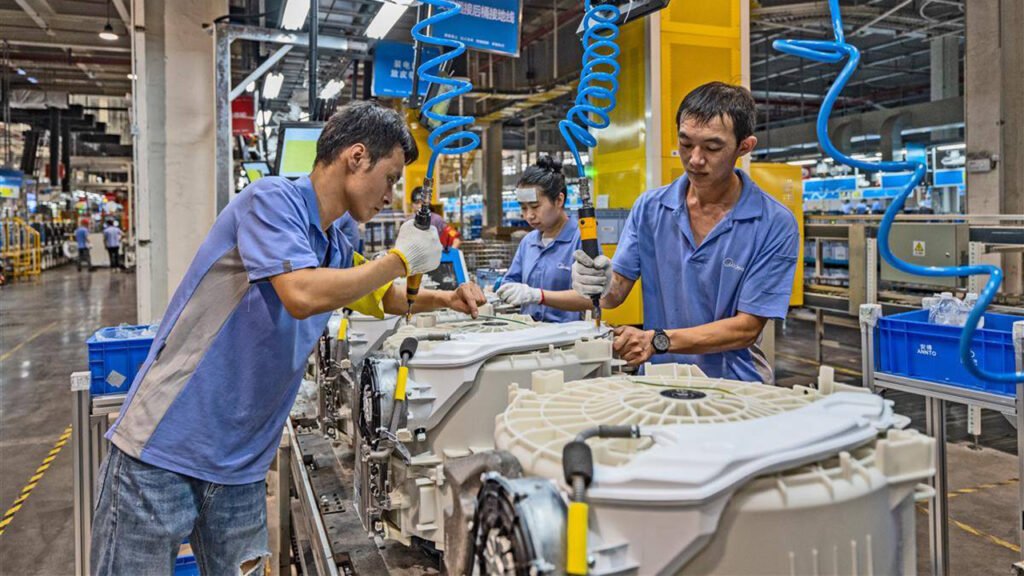
1. Core Process Flow of a Washing Machine Assembly Line
A typical washing machine assembly line generally follows the principles of “modular assembly” and “progressive integration.” The main process is as follows:
- Inner Drum/Washing Unit Assembly
- This is the “heart” of the washing machine. Steps include: assembling the stainless steel inner drum with the balance ring, main shaft, drive shaft, bearing housing, etc., and connecting and testing it with a three-phase inverter motor (or DD direct drive motor).
- This module is usually pre-assembled on a sub-line and then fed onto the main line as a core module.
- Cabinet and Shell Preparation
- Sheet metal stamped cabinets undergo edge treatment (to prevent cuts) and are then powder-coated or painted to form an attractive and durable shell.
- Install rear panels, drain pipe connectors, feet, etc.
- Outer Tub and Suspension System Assembly
- Mount the plastic outer tub (water container) along with shock absorbers (usually 4) and springs to the cabinet. This system is crucial for the machine’s vibration damping and quiet operation.
- Core Final Assembly
- Installing Inner Drum Assembly into Outer Tub: Precisely place the pre-assembled inner drum unit into the outer tub and connect the main shaft.
- Installing Counterweights: Top and/or bottom concrete or cast iron counterweights are fastened to maintain stability during high-speed spin cycles.
- Installing Control Panel and PCB: Mount the control panel (with various programs) and the main control printed circuit board to the front or top of the cabinet.
- Plumbing and Electrical System Integration
- Install water inlet hose, solenoid water inlet valve, water level sensor (pressure switch).
- Install drain pump and drain hose.
- Connect all wiring harnesses and connectors between the motor, sensors, door lock, and control board. This is key to electrical reliability.
- Front Door/Top Lid Installation
- For front-load washers, install the glass door and electromagnetic door lock.
- For top-load washers, install the top lid and transparent cover.
- Final Testing and Calibration
- Leak Test: Perform pressure hold tests on the inlet and drainage systems to ensure no leaks.
- Functional Test: Connect water and power, run a short test program to check all functions (washing, spinning, heating if applicable, draining) for proper operation.
- Safety Test: Conduct safety regulation checks like earth resistance, insulation strength (hipot test), and leakage current.
- Final Visual Inspection: Check for scratches, assembly flaws, etc.
- Packing
- Install shipping bolts (to secure the drum and prevent transport damage), place manuals, inlet hoses, and other accessories.
- Pack using foam padding and cartons, ready for warehousing.
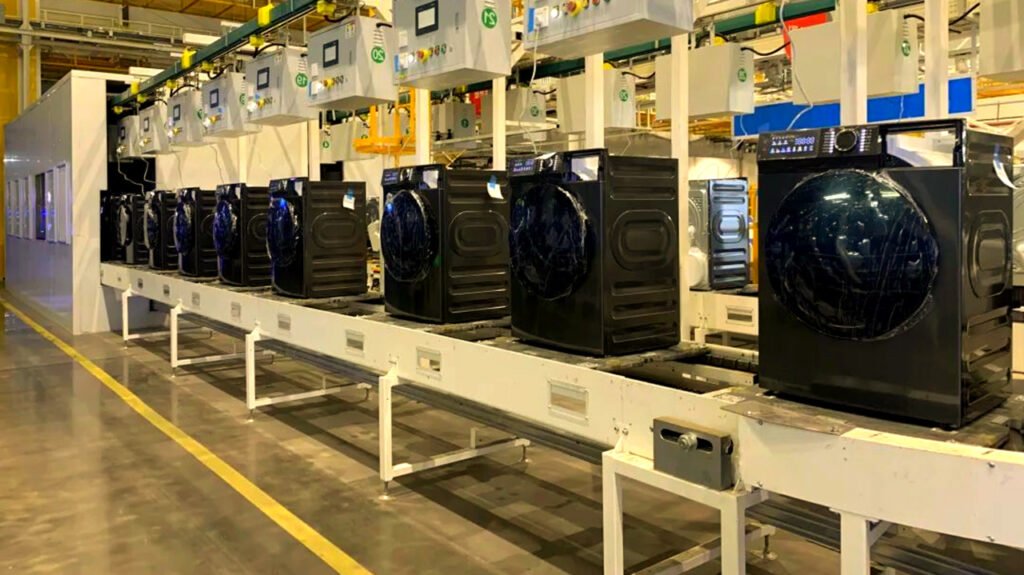
2. Key Points in Assembly Line Design and Layout
- Layout Types
- Straight Line (Conveyor Belt): Most common. Products flow along a main line with fixed sequence, clear rhythm, and easy management.
- U-shaped Line: Saves space. Material input and finished product output are on the same side, facilitating material delivery and worker collaboration.
- Modular Cell: Groups several processes into one workstation completed by a small team (e.g., the entire inner drum module). High flexibility, suitable for mixed-model production.
- Takt Time and Line Balancing
- Takt time is calculated based on production targets.
- The core challenge is line balancing: Distributing the total workload reasonably across each station so that each station’s operation time is as close as possible to the takt time, avoiding “bottlenecks” and “waiting.”
- Material Delivery
- Use ANDON systems or material call lights to notify logistics personnel for replenishment when station materials are running low.
- Use Set Parts Supply (SPS): All small parts (screws, washers, wiring harnesses, etc.) required for one washing machine are pre-kitted in one box that flows with the product. This reduces worker picking time and prevents wrong or missing installations.
- Ergonomics
- Assembly line design must consider worker comfort, such as height-adjustable pallets, assistive manipulators (for installing heavy counterweights), and providing appropriate tools. This reduces labor intensity and improves efficiency and quality.
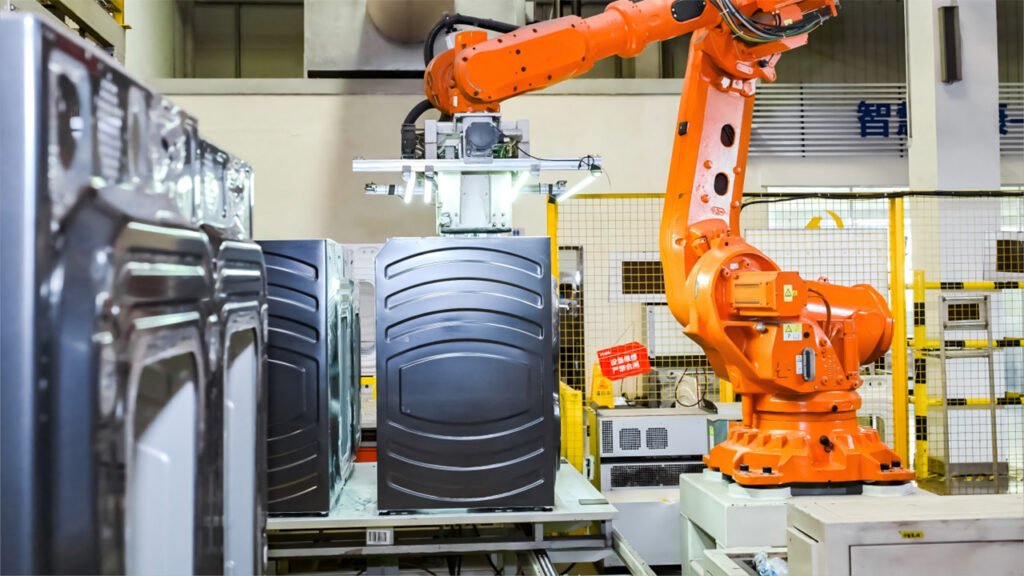
3. Application of Automation and Smart Technologies (optional)
Modern washing machine assembly lines are no longer purely manual; automation is increasingly prevalent:
- Automated Workstations:
- Automatic Screwdrivers: Used for torque-controlled tightening of critical screws (e.g., motor, counterweight screws) with traceable data.
- Robotic Gluing/Sealing: Provides automated, highly consistent glue application at connection points like between the outer tub and cabinet.
- Robotic Handling/Assembly: Uses 6-axis robots to handle heavy items like the inner drum assembly or install counterweights.
- Vision-Guided Systems: Guide robots for precise assembly or perform quality checks (e.g., inspecting label placement, panel fit).
- Informatization and Data Traceability (Industrial IoT – IIoT):
- Each washing machine gets a unique identity via RFID or barcode.
- Assembly data from key stations (e.g., tightening torque, test parameters) is linked to this identity, enabling full-process quality traceability.
- Systems like MES monitor real-time data on production status, equipment efficiency (OEE), product quality, etc., enabling digital management.
- Automated Testing and Inspection:
- Automated functional test benches that automatically complete the entire process (water/power connection, operation, draining) and determine the result.
- Automated safety testers integrated into the line.
Summary
An efficient washing machine assembly line is a deep integration of precise process planning, lean production management, automation technology, and digital systems. It is not just a place where thousands of parts are assembled into a product; it is the core manifestation of a manufacturer’s comprehensive competitiveness in quality, cost, delivery, and flexibility.
How to set up a Washing Machine Assembly Line factory?
Find the Testing Line or Equipment for Your Needs. Get expert support—request a quote or let’s talk about your project.
Need Coating Line or Coating Equipment? Get expert support—request a quote or let’s talk about your project.
Looking for VIN marking machines? Contact us for more information.
Looking for air compressors? Contact us for more information.
Need assembly tools? Contact us for more information.