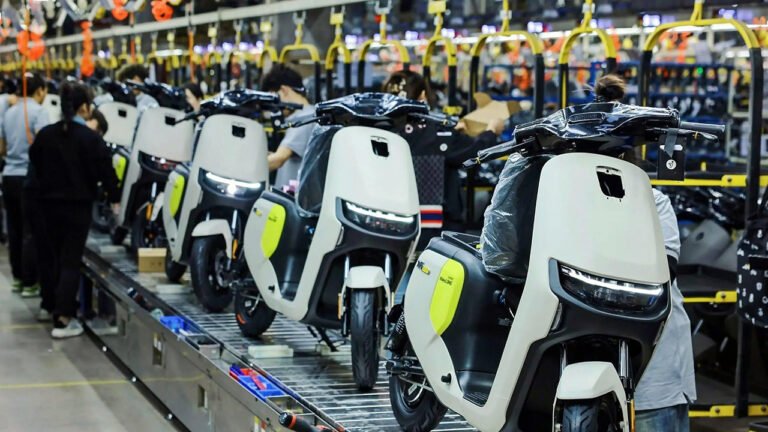
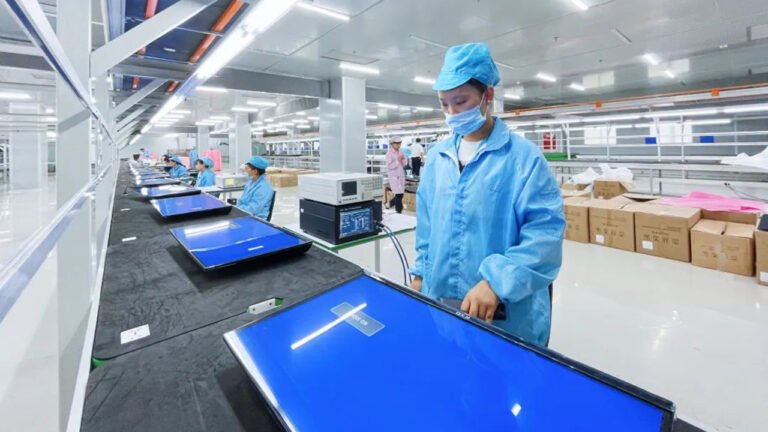
What is the Motorcycle Engine Assembly Line?—–Motorcycle Engine Assembly Line Factory
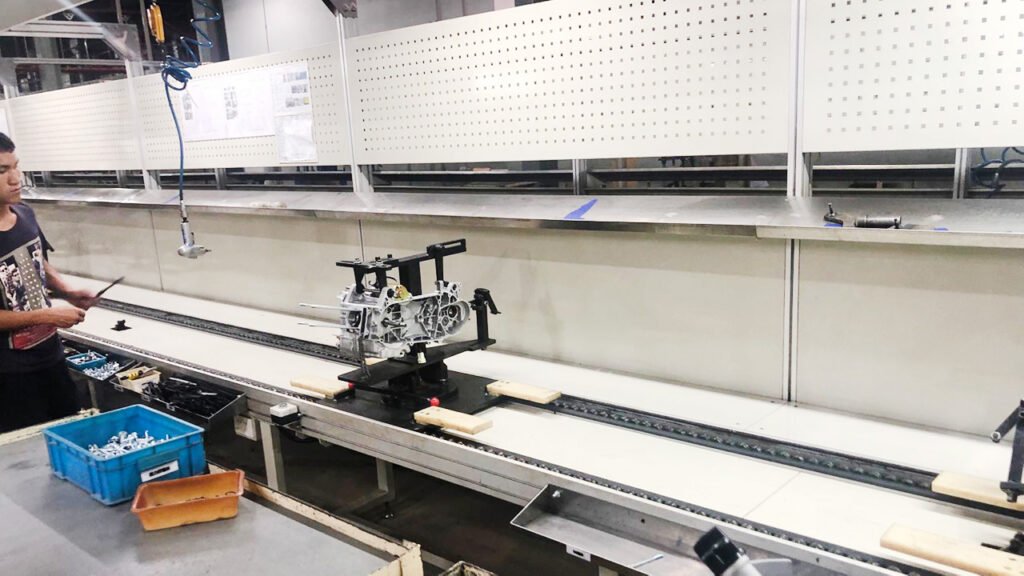
A Motorcycle Engine Assembly Line is an integrated automated system achieving high-quality assembly via modular sub-assembly, main-line assembly, in-line inspection and data traceability. It adopts a “one main + multiple auxiliary lines” layout, with core processes, key equipment and strict quality control. Suitable for 50–800cc mass-produced single/twin-cylinder engines, especially 100–300cc civilian models, but unsuitable for large-displacement multi-cylinder, racing or customized engines.
Motorcycle Engine Assembly Line are suitable to Assemble/Produce Motorcycle Engines. (If clients have more requirements or want to produce the other Motorcycle Engines or other engines, welcome to contact us.)
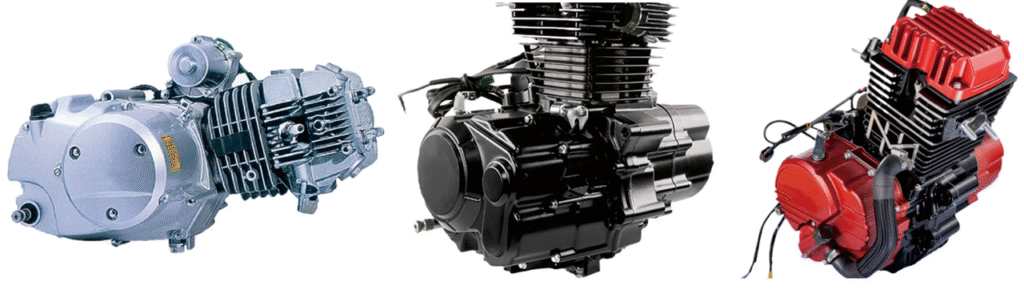
Motorcycle Engine Assembly Line Description
A motorcycle engine assembly line is an integrated, automated precision manufacturing system that achieves efficient, stable, and high-quality assembly of engines from individual components to complete units through modular sub-assembly, main-line assembly, in-line inspection, and data traceability.
I. Overall Layout of the Assembly Line
Modern motorcycle engine assembly lines mostly adopt a flexible layout of “one main line + multiple auxiliary lines” to balance efficiency and quality:
- Main Assembly Line: A circular / linear non-synchronous conveyor line that carries the general assembly of main engine components (crankcase, cylinder block, cylinder head) and serves as the core process.
- Auxiliary Sub-Assembly Lines: Independently complete the pre-assembly of high-precision and complex components, which are then fed into the main line as integrated units, greatly improving main-line efficiency.
- Cylinder Head Sub-Assembly Line: Assembles valves, valve springs, camshafts, oil seals, etc.
- Piston-Connecting Rod Sub-Assembly Line: Pre-assembles pistons, piston rings, piston pins, connecting rods and performs dynamic balance inspection.
- Crankshaft / Bearing Sub-Assembly Line: Pre-assembles crankshafts, main bearings, connecting rod bearings and inspects clearances.
- Transmission / Clutch Sub-Assembly Line: Pre-installs gears, shift forks, and clutch assemblies.
- Supporting Systems: Intelligent parts feeding, tightening workstations, in-line inspection, MES data management, cleaning / marking / leak testing / hot testing stations, etc.
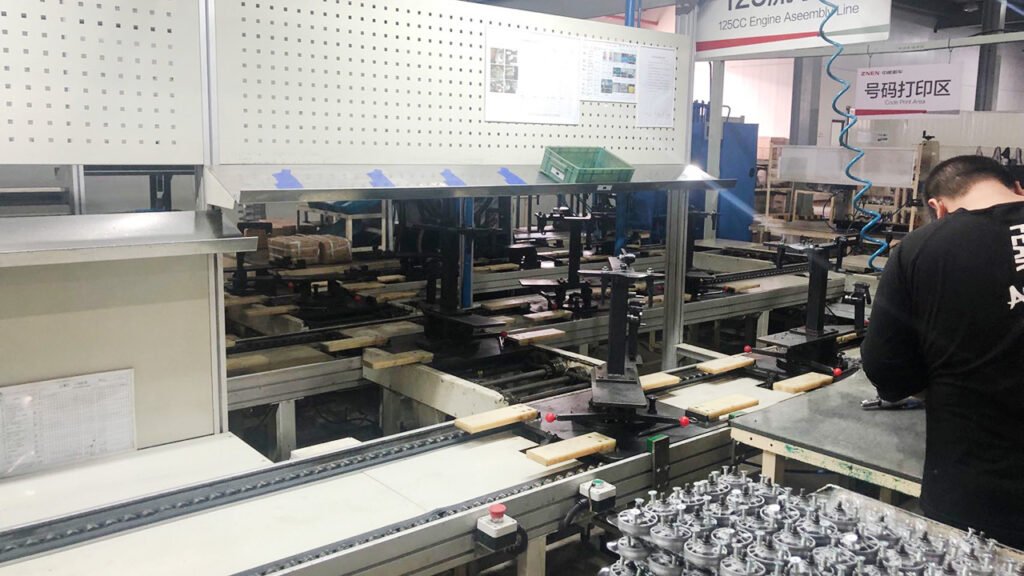
II. Core Process Flow (Main Line)
1. Line Entry & Preprocessing
- Left and right crankcases enter the line, with a unique engine VIN code engraved by laser.
- Crankcases are cleaned, positioned, and flipped for internal assembly.
2. Crankshaft & Bearing Assembly (Key Station)
- Main bearings and connecting rod bearings are pressed in by a servo press (installation qualification is judged by pressure curve).
- Crankshaft is positioned and installed; axial / radial clearance is inspected (typically 0.01–0.02 mm).
- Crankshaft oil seals and locating pins are installed; crankcase mating surfaces are sealed.
3. Piston-Connecting Rod Assembly
- Piston rings are installed with openings staggered at specified angles.
- Piston pin is hot / cold fitted to the connecting rod and secured with circlips.
- The piston-connecting rod assembly is pushed into the cylinder block with special tools and connected to the crankpin of the crankshaft.
- Connecting rod bolts are tightened under sequence + torque + angle dual control, with data uploaded to MES.
4. Cylinder Block & Cylinder Head Assembly
- Cylinder gasket is installed; cylinder block and cylinder head are aligned and positioned.
- Robots / automatic tightening machines fasten cylinder head bolts in a specified sequence.
- Timing chain, tensioner, and guide plates are installed; timing marks are calibrated.
5. Valve Train & Valve System
- Camshafts, valves, valve springs, tappets / rocker arms are installed.
- Valve clearance is adjusted cold to ensure smooth opening and closing.
6. Internal System Assembly
- Oil pump, oil passages, oil filter, and oil pan are installed; oil passage sealing is inspected.
- Starter motor, generator (stator / rotor), and ignition system are pre-assembled.
- Transmission gears, shift forks, and shifting mechanism are assembled with clearance inspection.
7. External Accessories & Sealing
- Carburetor / EFI system, air filter interface, and exhaust pipe interface are installed.
- All gaskets and bolts are re-tightened; leak prevention inspection is performed.
8. Off-Line Inspection (Quality Control)
- Air Tightness Test: Leak detection for cylinder pressure, oil passages, and water passages.
- Cold / Hot Testing: Simulated operation to detect abnormal noise, vibration, oil pressure, and ignition timing.
- Appearance & Functional Inspection: Cleaning, marking, labeling, and recording of complete engine parameters.
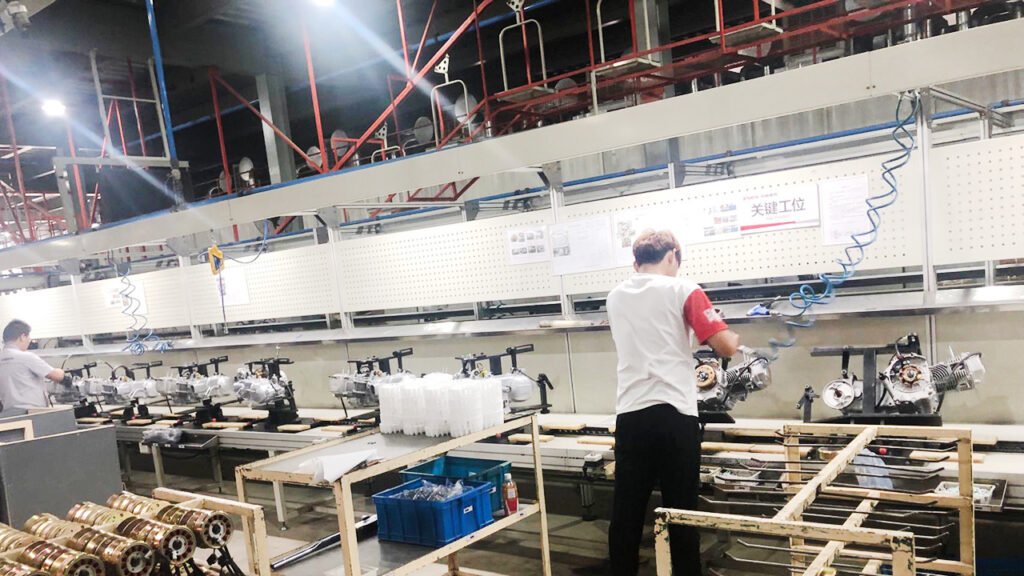
III. Key Equipment & Technologies
- Servo Tightening System: Dual control of torque + angle with full data traceability, eliminating missing or incorrect tightening.
- Servo Press Machine: Real-time monitoring of pressure-displacement curves to realize “assembly and inspection integration”.
- In-Line Inspection Equipment: Clearance measurement, dynamic balance, air tightness, vibration, and noise testing.
- MES Production Management System: Full-process data collection, quality traceability, error proofing, and work order management.
- Robot Workstations: Handling, tightening, gluing, and assembly to improve precision and consistency.
IV. Quality Control Key Points
- Clearance Control: Micron-level management of crankshaft / bearing, piston / cylinder, and valve clearances.
- Torque Control: Strict compliance with specifications for critical bolts (cylinder head, connecting rod, crankshaft).
- Sealing Control: 100% leak detection for all mating surfaces, oil seals, and oil passages.
- Timing Control: Accurate calibration of valve timing and ignition timing to ensure power and emission performance.
- Data Traceability: Full traceability of assembly parameters, test results, and material information for each engine.
V. Advantages of the Assembly Line
Low Cost: Reduced labor, lower defect rate, and shortened production cycle.
High Efficiency: Stable cycle time with controllable production capacity.
High Quality: Automation + in-line inspection greatly improve consistency and reliability.
Flexibility: Quick model changeover to support multi-model, multi-displacement production on the same line.
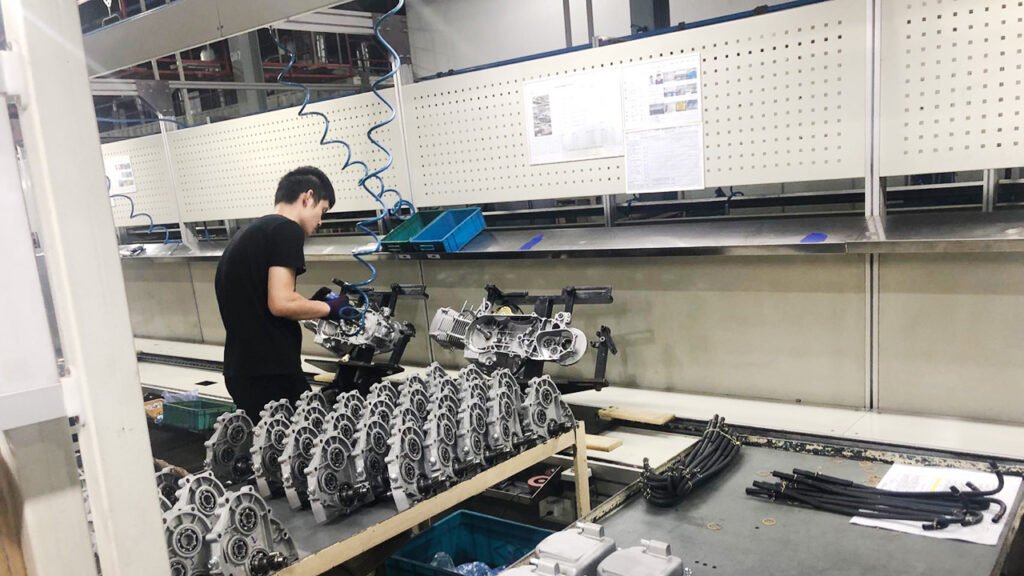
VI. Most Suitable Engines for This Assembly Line (Mainstream Mass-Produced Types)
These engines feature unified structures, highly standardized parts and large production volumes, making them fully compatible with automated assembly, tightening and testing.
- Horizontal Single-Cylinder Engines (Most Typical & Highest Volume)
- 100cc, 110cc, 125cc engines for underbone motorcycles
- General horizontal engines for small-displacement scooters
- Features: Simple structure, high consistency, fast production tempo; the core products for this type of assembly line.
- Vertical Single-Cylinder Air-Cooled / Oil-Cooled Engines
- General engines for street motorcycles: 125cc, 150cc, 200cc
- Classic designs such as CG125, CB150, GS125
- Features: Symmetrical crankcases, fixed bolt layout, highly suitable for automatic tightening, press-fitting and cold testing.
- Forced Air-Cooled Single-Cylinder Engines for Scooters (GY6 Type & Updated Models)
- Mainstream scooter engines: 125cc, 150cc
- Features: Standard left-right crankcase structure with built-in CVT; clutch and transmission can be pre-assembled on sub-lines before final integration.
- Mid-to-Small Displacement Water-Cooled Single-Cylinder Engines
- Water-cooled single-cylinders for sport / adventure models: 200cc, 250cc, 300cc
- Features: Equipped with water jackets requiring air / water tightness tests, perfectly matching the built-in leak testing and cold test stations of the assembly line.
- Parallel & Asynchronous Twin-Cylinder Engines (Mid-to-Small Displacement)
- Twin-cylinder engines: 250cc, 300cc, 400cc, 500cc
- Features: Symmetrical structure, fixed processes, suitable for mixed production on flexible assembly lines.
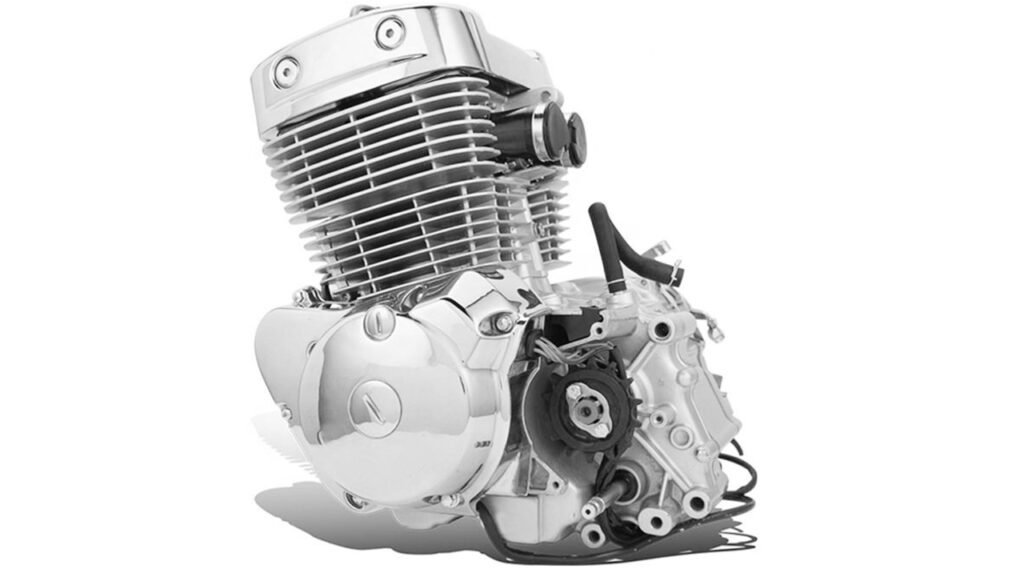
VII. Engines That Can Be Assembled with Flexible Tooling Changeover
These engines have slightly different structures but can be produced on the same line by changing fixtures and adjusting programs:
- 650cc, 800cc inline twin-cylinders
- V-twin engines (for retro and cruiser motorcycles)
- High-spec single-cylinders with balance shafts
- High-performance engines with DOHC (Double Overhead Camshaft)
All are compatible as long as the production line is a flexible non-synchronous type.
VIII. Engines Basically Unsuitable for This Automated Assembly Line
- Large-displacement multi-cylinder engines (inline-four, inline-three, V4)Complex structure, extremely high precision requirements and low output; usually produced on dedicated high-end engine lines rather than general motorcycle lines.
- Racing engines & modified enginesNon-standardized, low-volume, mainly assembled manually.
- Old two-stroke enginesGreat differences in structure, lubrication and sealing systems; generally not produced on the same line.
- Customized, niche retro hand-built enginesNot suitable for automated tempo production.
Simple Summary
This motorcycle engine assembly line, featuring main line + sub-assembly + automatic tightening + in-line inspection + MES traceability, is suitable for almost all mass-produced single-cylinder and twin-cylinder motorcycle engines ranging from 50cc to 800cc, especially for high-volume production of 100–300cc civilian scooters, street bikes and underbone motorcycles.