

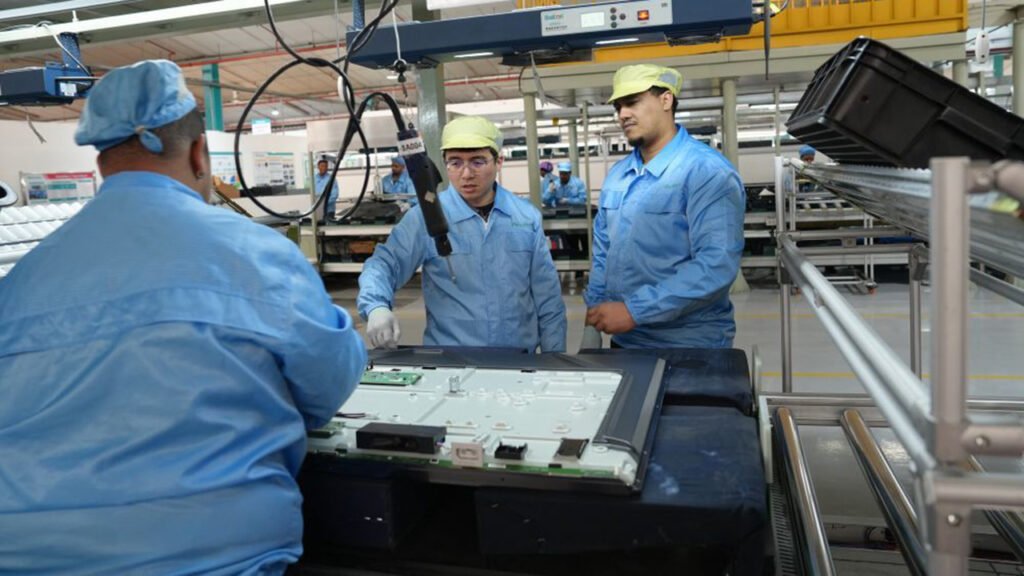
TV Core Structure, Assembly and Testing Process: A television primarily consists of a display module, mainboard, power supply board, audio system, and chassis. The core assembly is divided into two steps: first, the display module is precisely assembled in a cleanroom environment, followed by the integration of all components with the chassis on the final assembly line. Critical testing processes run throughout, including incoming material inspection, in-line screen and circuit testing, as well as the most crucial whole-unit aging tests, comprehensive signal and audiovisual functionality testing, and final visual inspection to ensure outgoing quality.
Assembly Line Configuration: Assembly Lines/Production lines can be categorized by automation level into fully automated, semi-automated (mainstream), and manual lines; by logistics layout into linear lines, efficient U-shaped cell lines, loop lines, etc.; and by specialization level into rigid lines for single-product models and flexible lines adapted for multi-variant production. Modern smart factories commonly adopt semi-automated flexible hybrid lines, which can be integrated with MES systems to achieve efficient and flexible mixed-model production with full traceability.
TV Assembly Lines are suitable to Assemble/Produce TVs. (If clients have more requirements or want to produce the other TVs, welcome to contact us.)
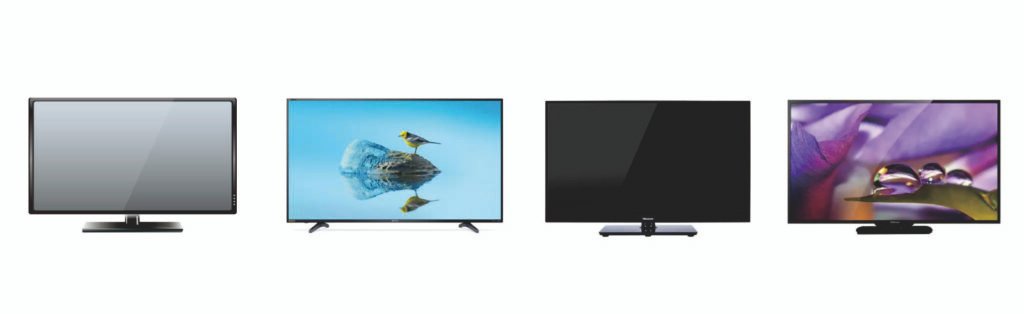
PART I: TV main structure, main assembly process and testing process
1. Core Structure
- Display Module: The most expensive part. Includes the LCD panel and the LED backlight behind it.
- Mainboard: The TV’s “brain,” responsible for processing signals and running the operating system.
- Power Supply Board (PSU): Converts household 220V AC power into the various DC voltages needed internally.
- Audio System: Speakers and their associated circuitry.
- Chassis/Enclosure: The front bezel holds the screen; the rear cover protects internal components and features ventilation holes and ports (like HDMI, USB).
2. Main Assembly Process
- Step 1: Assemble the Display Module
In a cleanroom environment, the backlight unit, light guide plates, and LCD panel are precisely layered like a “sandwich” to form a complete display module. - Step 2: Final Assembly of the Whole Unit
- The display module is secured into the front bezel.
- Circuit boards like the mainboard and power supply board are installed into the rear cover and connected with cables/ribbons.
- The speakers are installed.
- The front and rear covers are snapped together and screwed shut. Finally, the stand or feet are attached.
The entire process is using assembly lines and also chose to add robots.
3. Main Testing Process
- Incoming Quality Control (IQC): Incoming components are sampled and inspected.
- In-Line Testing:
- Screen Test: The screen is powered on, and cameras automatically detect dead pixels, bright spots, or uniformity issues.
- Circuit Test: Boards are powered to verify basic functionality.
- Final Unit Testing (Most Critical):
- Aging Test (Burn-in): Units run continuously for dozens of hours with test patterns to identify early failures.
- Signal Test: Automated test patterns (color bars, grids, etc.) are input to check picture quality, clarity, and all ports (HDMI, USB, etc.).
- Audio Test: Sound is played to check speaker functionality and quality.
- Smart Feature Test: Wi-Fi, apps, and the operating system are tested for smooth operation.
- Visual Inspection: Workers check the exterior for scratches, gaps, and overall finish.
- Packing Audit: Random units are pulled from the packaged stock for a final “out-of-box” experience check.
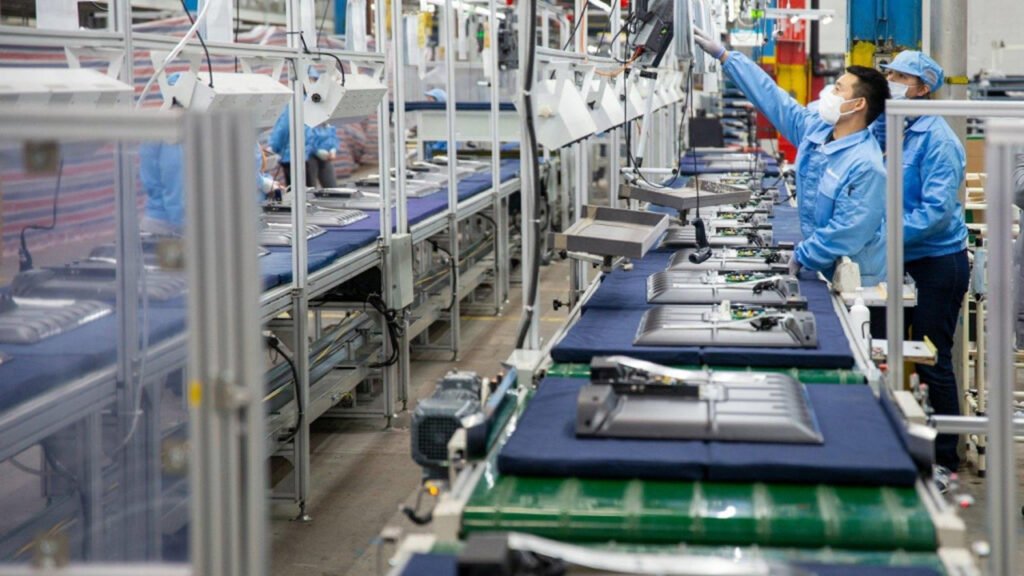
Part II: TV Assembly Lines can be categorized based on their level of automation, product type, and production scale. Modern factories typically combine multiple types to form hybrid production lines.
1. Categorized by Level of Automation
1.1 Fully Automated Assembly Line
- Characteristics:
- Core workstations are handled by industrial robots, Automated Guided Vehicles (AGVs), and precision fixtures.
- High precision, high consistency, high speed. Suitable for mass production of standardized products.
- Requires massive initial investment but has low long-term labor costs and stable quality.
- Typical Applications:
- Display Module Assembly: Robots handle panel picking, cleaning, and precise lamination.
- PCB Installation & Screw Fastening: Robots automatically pick/place mainboards, power boards, and fasten screws.
- Unit Handling & Reorientation: AGVs or fully automated conveyor systems move units between stations.
- Automated Functional Testing: Equipment automatically connects interfaces, plays test signals, and evaluates results via cameras/sensors.
1.2 Semi-Automated Assembly Line (currently the most common mainstream configuration)
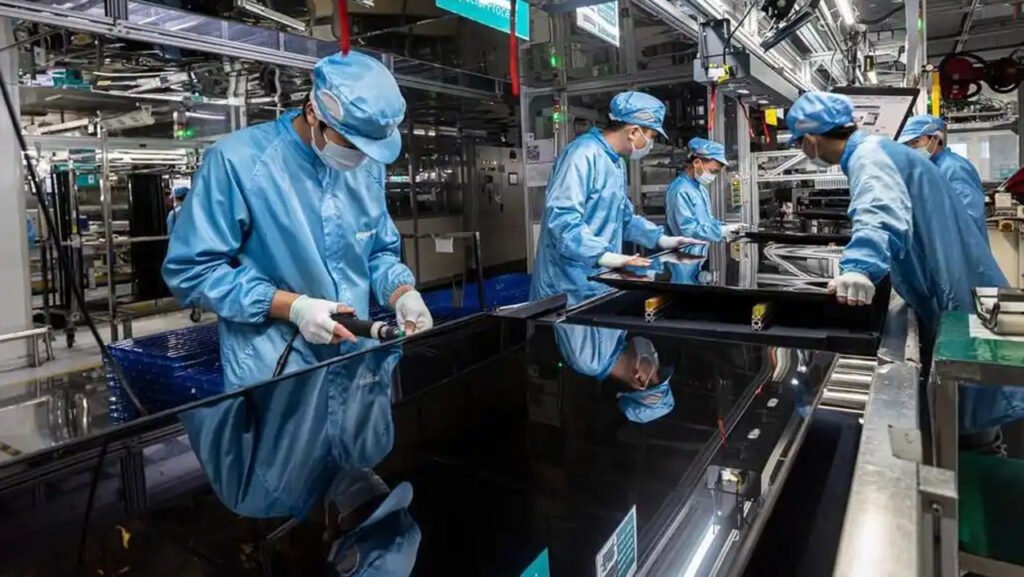
- Characteristics:
- A “human-machine collaboration” model,
- Machines handle heavy, high-precision, or repetitive tasks. Humans handle tasks requiring high flexibility, judgment, or assembly of small parts.
- Strikes the best balance between cost, efficiency, and flexibility.
- Typical Applications:
- Manual tasks: cable connection, foam pad attachment, accessory placement.
- Machine tasks: automated screen testing, screw fastening, software flashing.
- Often uses belt conveyors or slat chain conveyors combined with robotic arms and automated workstations.
1.3 Manual / Basic Assembly Line
- Characteristics:
- Primarily relies on manual operations with simple equipment.
- Low investment, extremely high flexibility. Suitable for low-volume, high-mix production, such as customized displays, prototype builds, or repair stations.
- Production efficiency and quality consistency heavily depend on worker skill.
- Typical Format:
- Consists of workbenches, pneumatic tools, and manual testing equipment.
2. Categorized by Layout & Material Flow
2.1 Linear Flow Line
- Characteristics: Workstations are arranged sequentially in a straight line; products move linearly. Simple structure, easy to manage.
- Suitable for: Production with fewer steps and a single product type. The most basic, traditional layout.
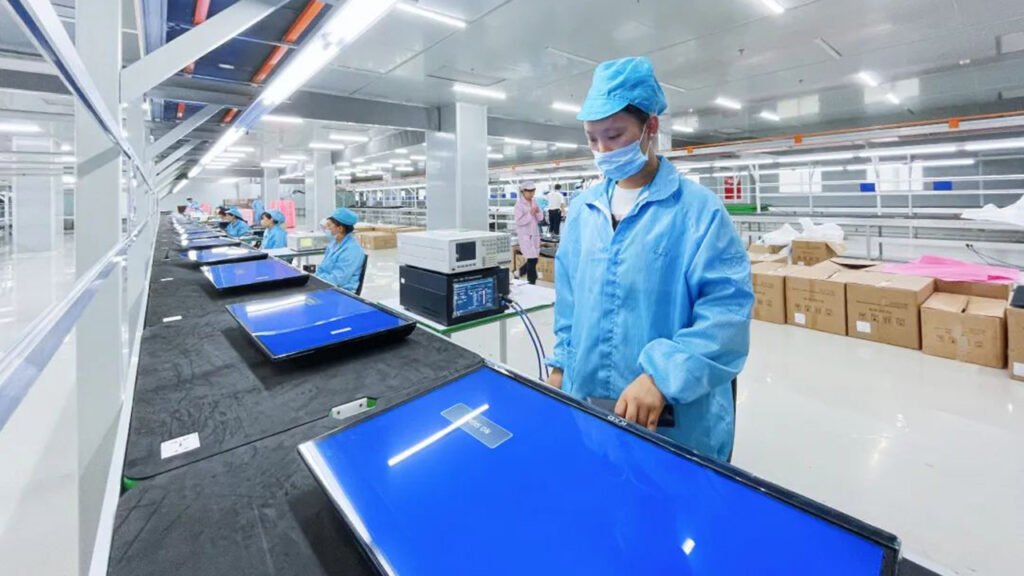
2.2 U-shaped Cell Line
- Characteristics: The line is arranged in a “U” shape, with the entry and exit points on the same side.
- Advantages:
- Reduces material and personnel movement, improving space utilization.
- Facilitates multi-machine handling by one operator or small-team collaboration, offering flexibility to adapt to output changes.
- Conducive to “one-piece flow” production, reducing work-in-progress inventory.
- Suitable for: Modern factories employing lean manufacturing principles, often used for module assembly or packaging sections.
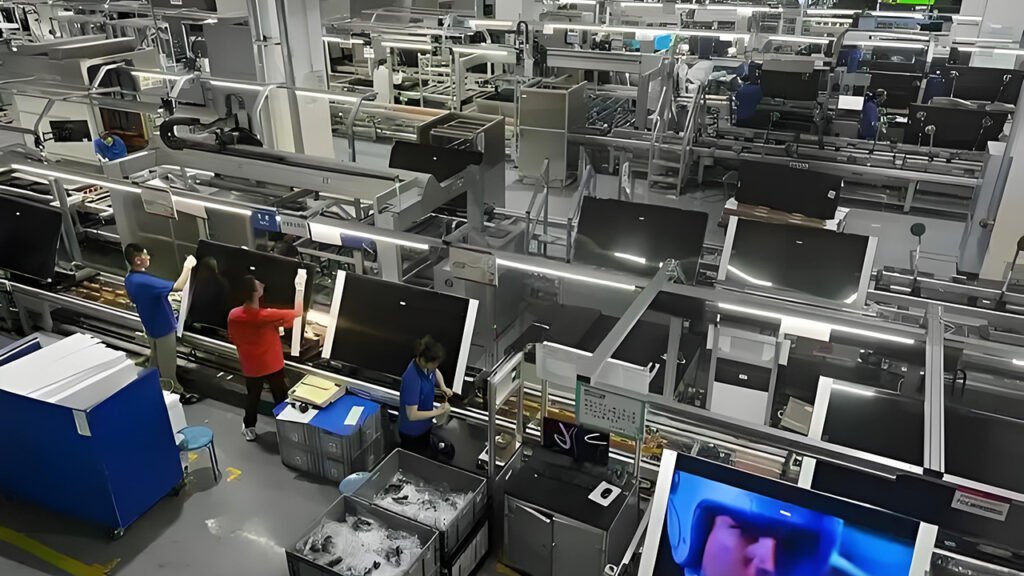
2.3 Loop Line
- Characteristics: The production line forms a closed loop, with the end connected to the beginning.
- Advantages: Allows for an integrated burn-in/aging test loop — TVs run test programs automatically on the line for several hours. After aging, they proceed directly to the next station without needing offline handling and re-introduction, saving space and logistics.
- Suitable for: Products requiring extended on-line aging or testing.
2.4 Slat Chain / Non-Synchronous Line
- Characteristics: Uses metal slat chains as carriers, offering high load capacity. Can feature “non-synchronous” or “pallet stop” functions, where a section at a workstation detaches from the main line’s pace. This provides an independent, stationary platform for workers/machines to perform operations, before automatically re-syncing.
- Advantages: Maintains production takt time while providing flexible operation time at each station.
- Suitable for: Final assembly of TV sets (handling heavier components), packaging stations.
3. Categorized by Specialization Level
3.1 Rigid / Dedicated Assembly Line
- Characteristics: Designed specifically for one TV model or size. Fixtures and robot programs are fixed.
- Advantages: Extremely high efficiency, fully optimized.
- Disadvantages: Lacks flexibility. Model changeovers require significant adjustment or even reconfiguration. Suitable for high-volume, long-lifecycle “flagship” models.
3.2 Flexible Assembly Line
- Characteristics: Equipment on the line has quick-changeover capabilities.
- Robots: Use vision systems to identify different models or quickly switch programs.
- Fixtures & Tooling: Use adjustable or modular designs to accommodate different TV sizes.
- Information Guidance: Scanning a product barcode triggers displays to show the corresponding assembly instructions and test programs.
- Advantages: Can adapt to the market trend of high-mix, low-volume production. A key direction for smart manufacturing.
- Suitable for: Mass customization, where one line can produce multiple sizes and models mixed together.
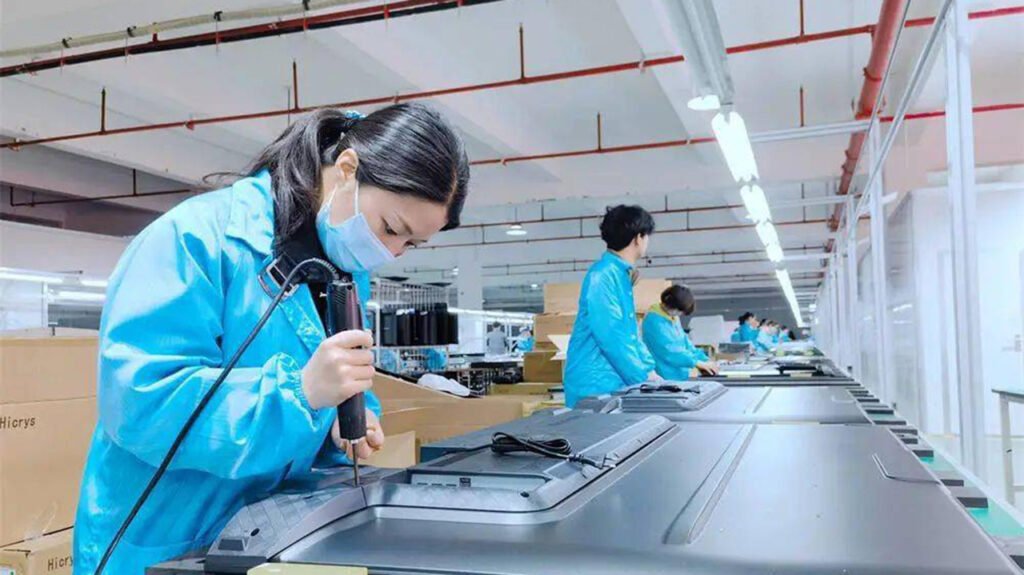
We can customize according to the client’s product specifications, production capacity or other requirements.
We provide comprehensive services including design, production, and installation/commissioning.