

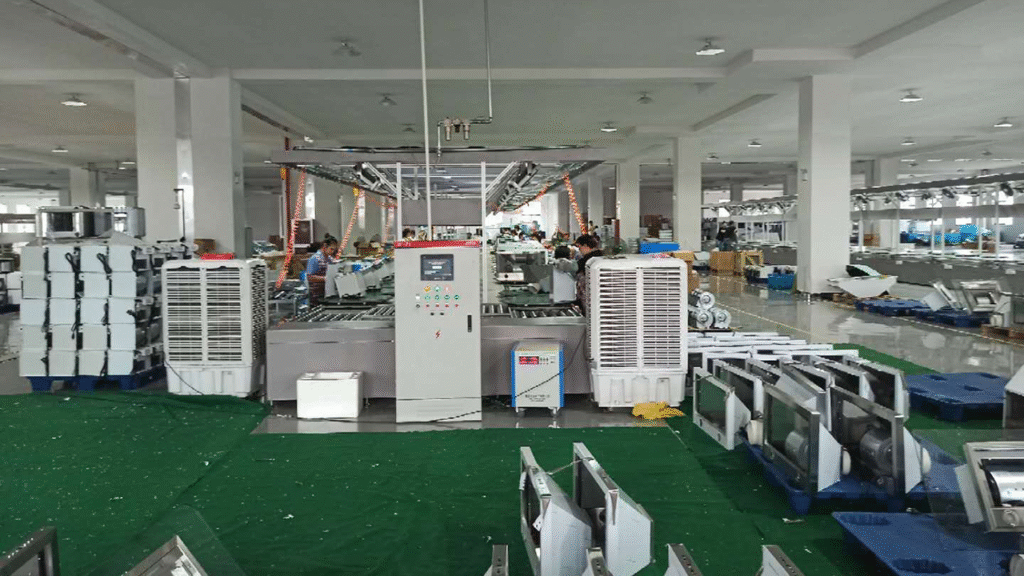
Modern Range Hoods production relies on specialized assembly lines designed for their large size and complex components. The process follows a “modular pre-assembly → mainline assembly → functional testing” workflow using customized tooling and flexible stations to accommodate various models. Inspection is integral throughout manufacturing, from incoming material checks to in-process controls and final product testing, ensuring safety and performance.
Range Hoods Assembly lines are tailored to handle high-precision requirements, balancing efficiency with the ability to manage intricate part integrations. This systematic approach enables efficient, adaptable, and quality-controlled manufacturing of modern range hoods.
Range Hood Assembly Lines are suitable to Produce Range Hoods. (If clients have more requirements or want to produce the other Rang Hoods, welcome to contact us.)
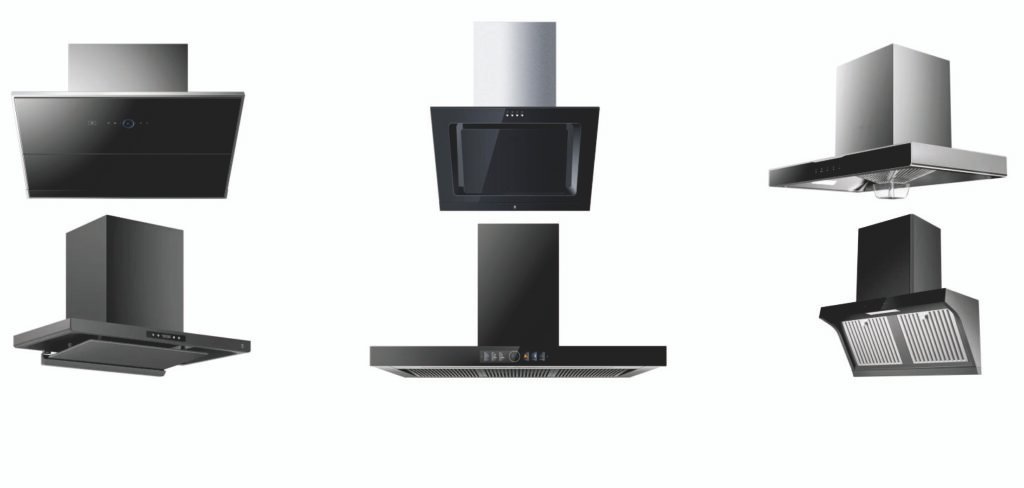
I. Main Structure of a Range Hood
A modern range hood is a product integrating aerodynamics, mechanics, electronics, and materials science. Its structure can be divided into four main modules:
1. External Structural Module
- Housing/Body: The main frame, typically made of 304 stainless steel or cold-rolled steel (surface-treated with painting, baking, or film lamination). It must be aesthetically pleasing, corrosion-resistant, and easy to clean.
- Grease Collector/Smoke Baffle: Located at the bottom, responsible for capturing cooking fumes at the source. Comes in various forms: the deep cavity design of overhead hoods, the slanted surface or barrier of side-draft hoods, and the recent popular downdraft or ultra-thin close-draft styles. Some high-end models feature automatically opening/closing butterfly panels.
- Grease Filter/Filtering Assembly: The core front-line filtering component. Common types include:
- Stainless Steel Multi-Layer Mesh: Mechanically intercepts grease; reusable and washable.
- Non-Stick Coated Mesh (e.g., Teflon): Facilitates grease run-off.
- Polymer Composite Deodorizing Filter: Intercepts grease while absorbing odors.
- Control Panel: The user interface, which may include mechanical buttons, capacitive touch screens, gesture-sensing areas, LCD displays, etc.
- Oil Cup/Container: Collects grease condensed and dripping from the filter and internal air passages. Usually a removable transparent plastic component.
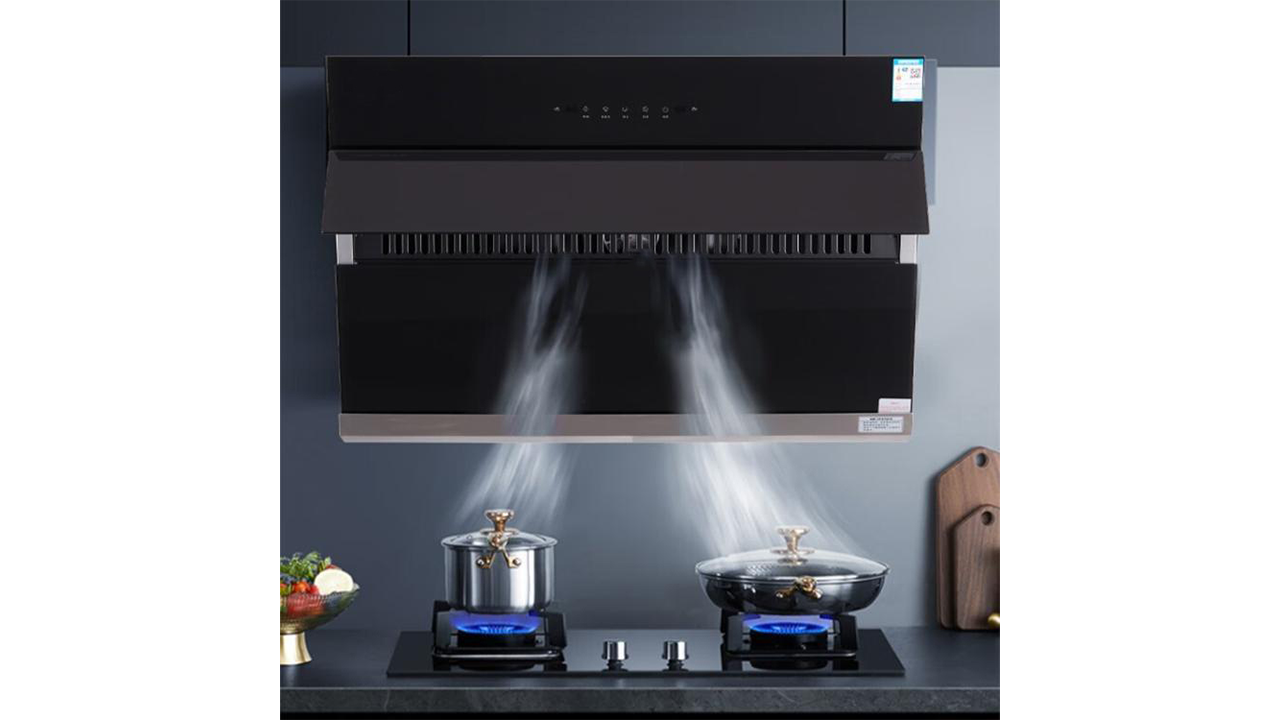
2. Core Power and Air Passage System
- Motor: The “heart” of the unit. Two main types:
- AC Fixed-Speed Motor: Simple structure, lower cost, typically offering 2-3 speed settings.
- DC Inverter Motor: The current mainstream choice for high-end models. Enables infinitely variable speed control, lower noise, higher energy efficiency, longer lifespan, and can automatically adjust static pressure based on duct resistance (auto boost function).
- Impeller (Blade Wheel): The “lungs” of the unit. Often a multi-blade centrifugal impeller, made of high-strength injection-molded plastic (e.g., PC+GF) or aluminum alloy. Its blade shape, angle, and dynamic balance precision directly determine airflow, static pressure, and noise levels.
- Volute (Air Passage System): The “respiratory tract”. The aerodynamic casing enclosing the impeller. Excellent design (e.g., bionic volute, dual-channel systems, flow-straightening covers) can significantly reduce turbulence, improve air efficiency, and lower noise. Materials are often engineering plastic or galvanized steel.
3. Electrical and Control System
- Main Control Board (PCBA): The “brain”. Receives signals from all sensors and user inputs, controlling motor speed, lighting, display, etc.
- Sensors: Such as temperature sensors (for dry-fire protection or auto-start), gesture sensors, air quality sensors (enabling automatic mode).
- Lighting System: Universally uses LED cold lights, requiring sufficient brightness, good color rendering, and long life.
4. Auxiliary and Safety Systems
- Check Valve (Backdraft Damper): Installed at the outlet to prevent backflow from communal ducts.
- Fire Safety Devices: Such as overheat protectors, fuses.
- Self-Cleaning System (Optional): Internal mechanisms for functions like heat-induced grease melting, high-temperature steam cleaning, or high-pressure water washing.
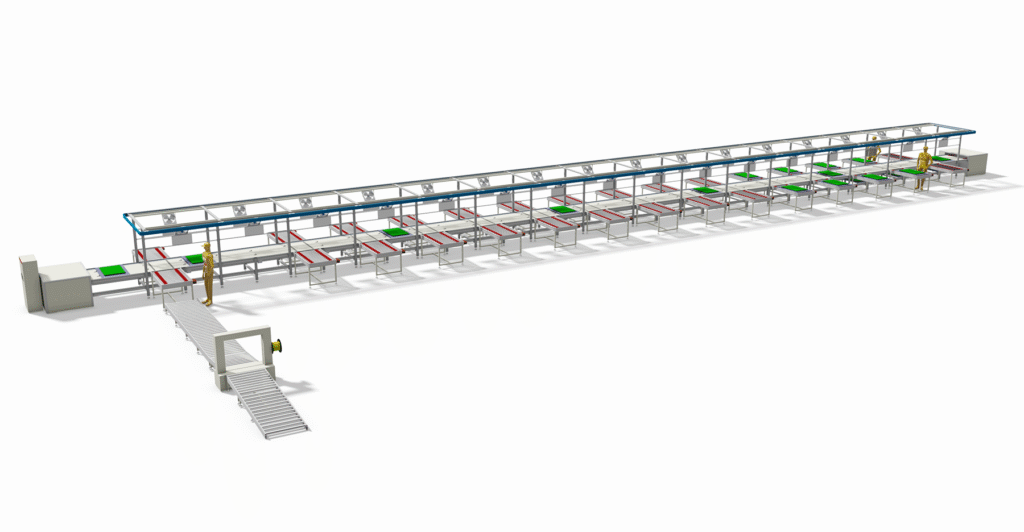
II. Assembly Process Flow
Assembly follows a modern production model: “Modular Pre-assembly → Mainline Assembly Flow → Functional Testing.”
1. Pre-assembly and Preparation Stage
- IQC (Incoming Quality Control): Sampling inspection of all components (sheet metal, plastic parts, motors, electronic parts) for dimensions, appearance, and performance.
- Module Pre-assembly:
- Fan Module Assembly: Precisely install the motor and impeller into the volute, perform dynamic balance calibration (a critical step), and then test the complete assembly.
- Control Module Assembly: Install the main control board into the switch box or panel, solder connecting wires.
- Lighting Module Assembly.
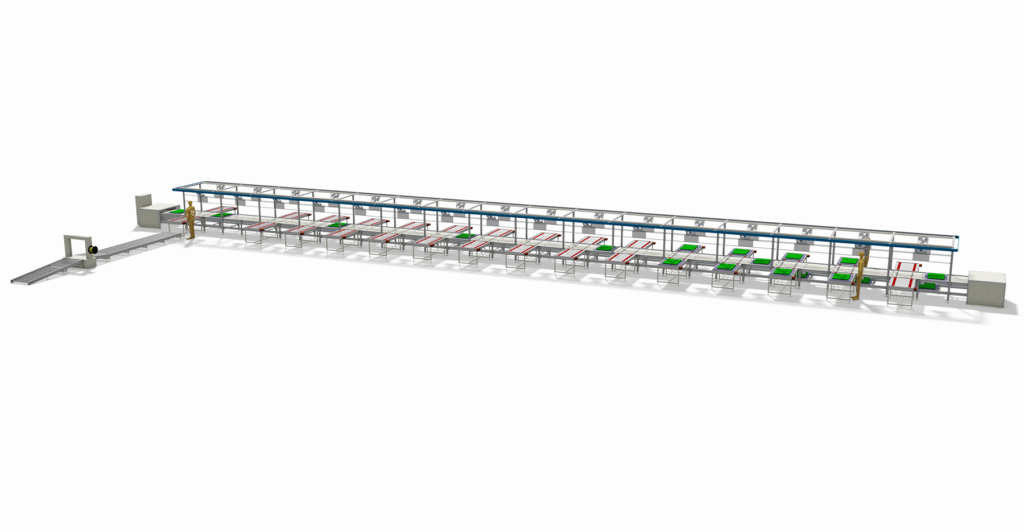
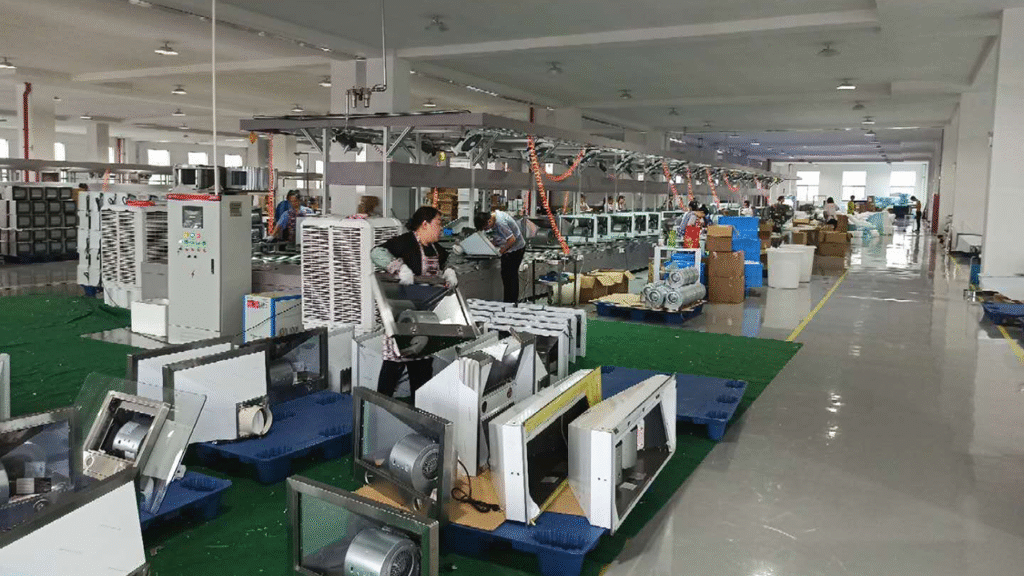
2. Mainline Assembly Flow (Assembly Line)
- Base Plate/Body Loading: Mount the welded and polished main housing onto the assembly line fixture.
- Internal Assembly:
- Install the Main Control Board Assembly and connect internal wiring.
- Install the Fan Module Assembly, connect motor power and signal wires. Anti-vibration pads and sealing rings are applied at connection points.
- Install the Lighting Module.
- Wire Routing and Securing: Use cable ties and clips to ensure wires do not interfere with moving parts.
- External Assembly:
- Install the Grease Collector/Smoke Baffle and its opening/closing mechanism (motor, linkage).
- Install the Grease Filter and its mounting frame.
- Install the Decorative Cover/Panel.
- Install the Oil Cup.
- Final Assembly and Packaging:
- Install the Check Valve, affix the energy label, nameplate, and warning labels.
- After final visual inspection, perform protective packaging (plastic bag, foam, carton).
3. Key Process Control Points
- Fastening Process: Use electric screwdrivers with preset torque to ensure consistent and meet the torque for critical areas (e.g., motor, fan unit).
- Sealing Process: Connections between the fan and volute, and the volute and outlet, must use oil-resistant, high-temperature sealant or silicone gaskets to prevent leaks that affect static pressure.
- ESD (Electrostatic Discharge) Protection: Electronic workstations must have anti-static measures (grounding straps, wrist straps).
III. Inspection Process (Full-Process Quality Control)
Inspection is the lifeline ensuring product safety, performance, and reliability, and runs through the entire process.
1. In-Process Inspection
- IQC: As mentioned.
- IPQC (In-Process Quality Control): Checkpoints at key stations on the assembly line to monitor assembly quality and process compliance.
- Module Functional Testing: Independent power-on testing of pre-assembled modules like the fan unit and circuit boards.
2. Finished Product Mandatory Testing (100% Full Inspection)
- Safety Performance Tests (Safety Regulation Tests):
- Dielectric Withstand Test (Hi-POT): High-voltage test for insulation strength.
- Grounding Continuity Test: Ensures reliable grounding.
- Leakage Current Test: Ensures levels are within safe limits.
- Power and Input Test: Verifies rated parameters.
- Basic Functional Tests:
- Normal operation of all fan speed settings and light switches.
- Responsive and accurate touch/gesture controls.
- Normal operation of smart functions like auto boost, delay shut-off.
- Smooth opening/closing of smoke baffles.
3. Final Audit and Packaging Inspection
- Final Visual Inspection of Whole Unit: Eliminates scratches, dents, stains.
- Accessory Count and Packaging Verification.
IV. Introduction to Differential Chain Assembly Lines for Range Hoods
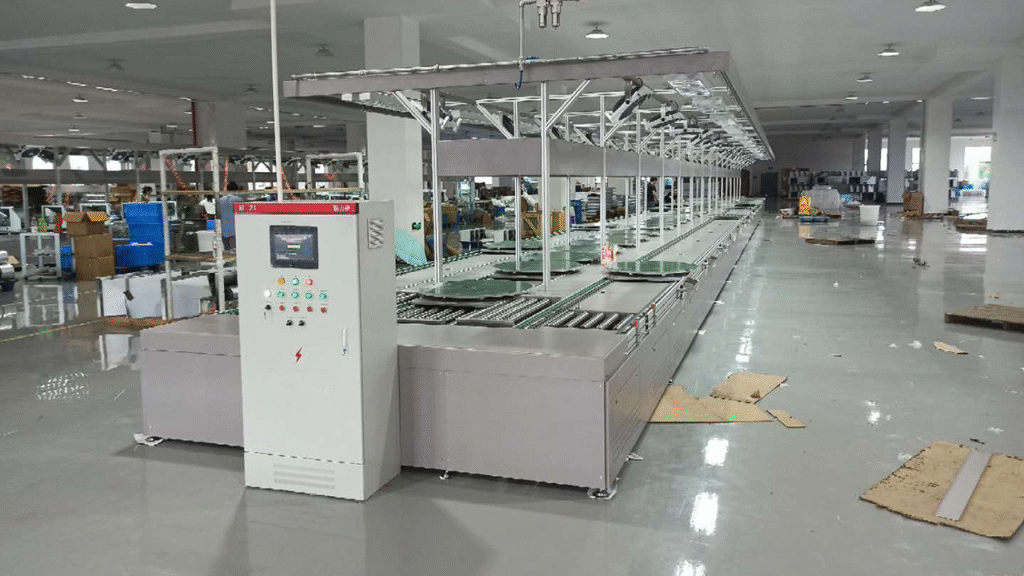
A differential chain assembly line for range hoods is a specialized automated production line used for assembling household appliances like range hoods. Its core feature is the ability to move the product-carrying “pallets” at a speed faster than the chain itself (typically 2-3 times), enabling high-efficiency assembly while ensuring smooth transportation.
Line Structure and Working Principle
This type of production line is typically designed as a closed loop, consisting of the following main components:
- Differential Chain: This is the foundation of the line. The special roller structure on the chain is the key to achieving the “differential” speed. When the chain moves forward at a constant speed, the pallets above gain a higher moving speed through friction with the rollers.
- Pallets and Positioning Devices: Pallets carry the range hood components. Each workstation is equipped with lift-and-stop blockers. When a pallet arrives at a designated workstation, the blocker rises to secure it precisely for operator work. After the task is complete, the blocker lowers, and the pallet continues its flow.
- Power and Control Module: Powered by motors, reducers, and frequency converters for drive and speed adjustment. The entire line’s operation, including start, stop, and pallet return, is controlled by a Programmable Logic Controller (PLC).
- Auxiliary Systems: The entire line is equipped with power outlets, lighting, pneumatic interfaces, anti-static systems, and workbenches for tools and materials.
Typical Assembly Process Flow
The assembly of a range hood is typically broken down into dozens of sequential steps. Using a standard differential chain assembly line as an example, the process can be summarized as follows:
- Loading: The main housing of the range hood is placed onto a pallet at the first workstation.
- Step-by-Step Assembly: The production line sequentially transports the unit to various workstations. Operators or equipment perform tasks in order, such as installing the fan system, circuit boards, control panel, and grease filters.
- Online Testing: At the end of the line or at designated test stations, the fully assembled range hood undergoes power-on, functional, and safety regulation testing.
- Unloading and Return: The finished product is unloaded for packaging. Empty pallets are returned to the starting point via an automatic pallet return system at the bottom of the line, forming a continuous loop.
Core Advantages
Utilizing a differential chain assembly line in range hood production offers several key benefits:
- High Efficiency: The differential transport allows pallets to move faster, and automatic positioning reduces wait time between processes, stabilizing the production cycle time.
- Strong Flexibility: The number and spacing of workstations can be flexibly adjusted and expanded according to product models and process requirements.
- Stable Quality: PLC control ensures process standardization; precise workstation positioning guarantees assembly consistency; anti-static design protects sensitive electronic components.
- Optimized Ergonomics: Integrating materials and tools beside workstations reduces operator fatigue and improves the working environment.
We can customize according to the client’s product specifications, production capacity or other requirements.
We provide comprehensive services including design, production, and installation/commissioning.