

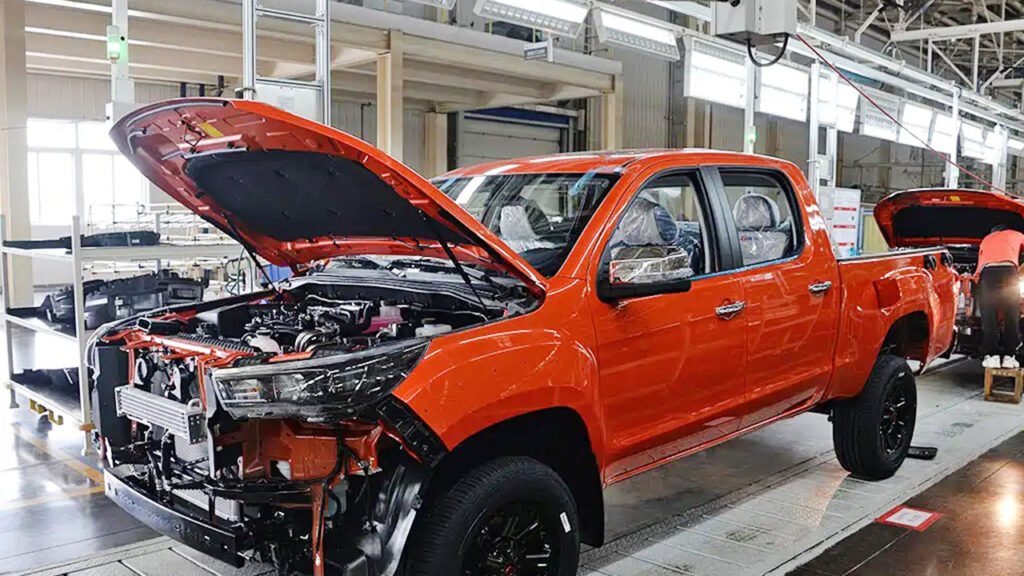
Pickups adopt body-on-frame structure with ladder frames, equipped with large-displacement turbocharged engines and four-wheel drive systems. Their assembly includes parts inspection, chassis, body and powertrain assembly, while testing covers safety, emission, structural strength and other dimensions.
Pickup assembly lines are large-scale automated flow production lines, consisting of pre-assembly area, main assembly line and final assembly & finishing area. They feature heavy-load adaptability, integration of automation and manual operations, real-time quality control and mixed-model production. Vehicles can be delivered only after passing post-assembly tests.
Pickup Truck Production Lines/Assembly Lines are Suitable to Produce/Assemble pickups, pickup trucks, and so on.(If customers request, we also can design the Production Line/Assembly Line suitable for pickups, sedans and cars, depends on exact vehicle models.)

Part I. Structure, Assembly and Testing Processes of Pickup Trucks
Structure of Pickup Trucks
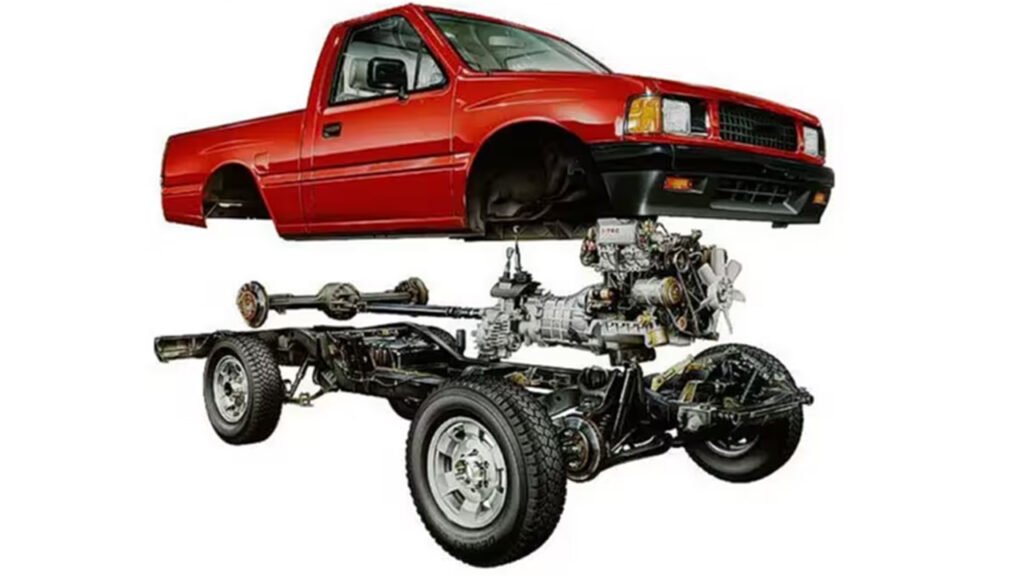
Pickup trucks usually adopt a body-on-frame structure with an independent ladder frame chassis. The body is composed of two high-strength longitudinal beams running through the front and rear of the vehicle, supplemented by multiple cross beams welded to form a rigid ladder or rectangular frame, thus creating a complete load-bearing skeleton. The cab and cargo box are flexibly connected to the frame via rubber pads or springs. In terms of the powertrain, pickup trucks are generally equipped with large-displacement turbocharged gasoline or diesel engines, matched with reinforced transmissions and part-time/full-time four-wheel drive systems. The suspension system mostly uses leaf spring rear suspension to improve heavy-load stability and durability.
Assembly Processes of Pickup Trucks
- Parts Preparation and InspectionClassify, clean and inspect all parts to be assembled. Use special testing equipment to conduct precise measurements of the size and shape of the parts, and carry out anti-corrosion treatment on the components. For example, use a laser measuring instrument to measure the frame to ensure that the error of its length, width and height does not exceed 0.5 millimeters; perform electrophoretic coating on the body sheet metal parts.
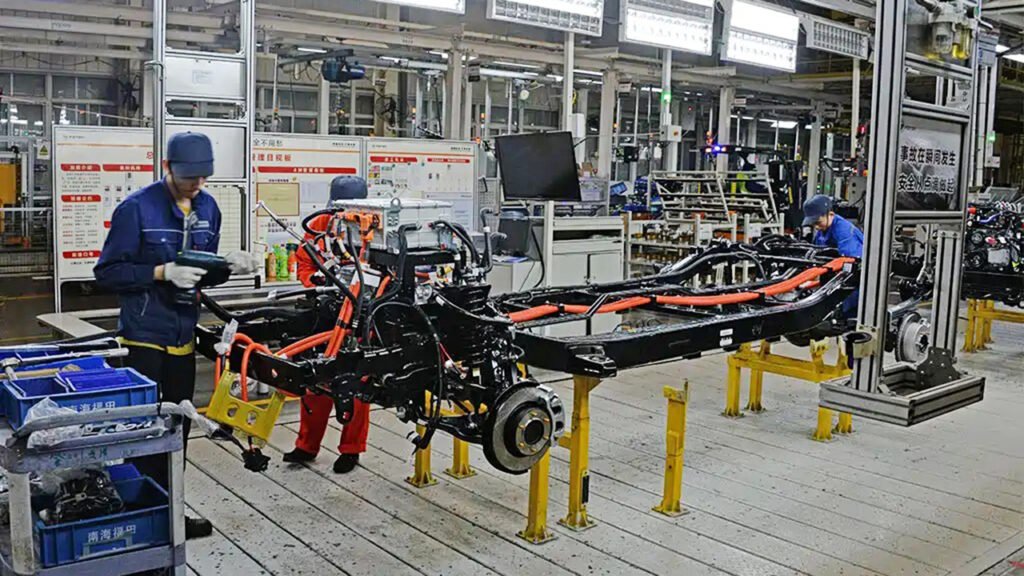
- Chassis AssemblyAll components of the chassis, such as the frame, suspension system and steering system, need to undergo strict quality inspection. The assembly accuracy of the frame is extremely high. The assembly of the suspension system should ensure that the installation positions and angles of the suspension arms, shock absorbers, springs and other components are accurate. After the chassis assembly is completed, a dynamic test will be carried out on the vehicle to verify the performance of the chassis system.
- Body AssemblyIt includes the installation of body panels, the assembly of windows, doors and other components, as well as the installation of interior decorations. The welding accuracy of body panels is required to be high. Windows and doors should ensure sealing performance and smooth opening and closing. The installation of interior decorations requires that the color, material and size of the components match the body.
- Engine and Transmission System AssemblyClean and inspect all components of the engine to ensure no oil stains or rust. During the engine assembly process, there are strict requirements on the installation sequence and torque value of the internal parts of the engine.
Testing Processes of Pickup Trucks
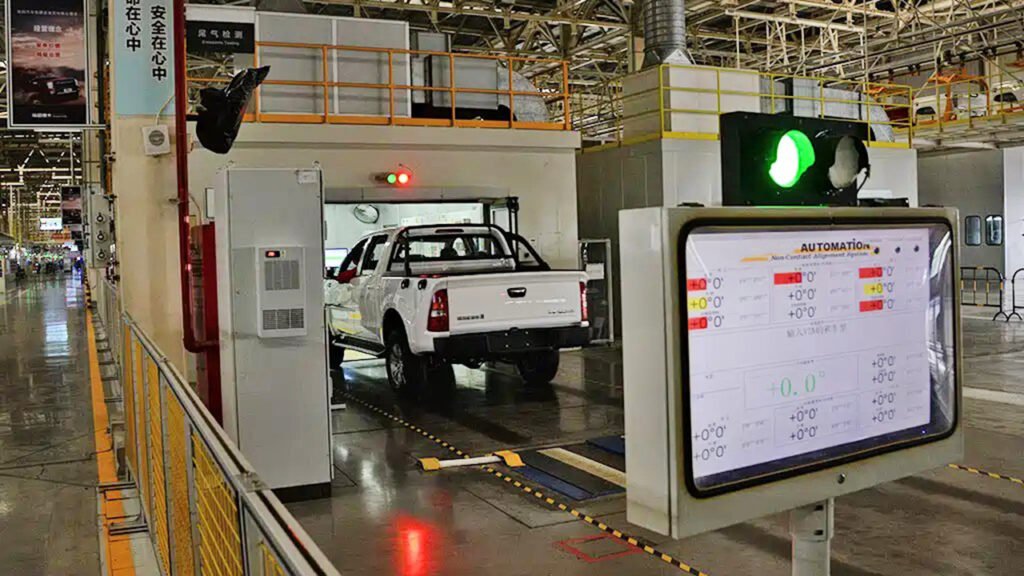
- Safety Performance TestingIt includes braking system efficiency test, steering mechanism clearance measurement, tire tread depth and tire pressure monitoring, etc.
- Emission and Environmental Protection TestingImplement double idle speed exhaust gas analysis, on-board diagnostic system function verification, fuel evaporation control system tightness test, etc.
- Structural Strength VerificationFocus on testing the load deformation of the cargo box floor, flaw detection test of the welding points of the cargo rack, bending fatigue strength test of the frame longitudinal beams, etc.
- Electrical System EvaluationIt includes the insulation resistance test of the whole vehicle wiring harness, the measurement of lamp illumination and optical axis deviation, the verification of the cold cranking ampere (CCA) of the battery, etc.
- Dynamic Performance TestingCarry out the measurement of the intervention response time of the electronic stability control (ESC) system, the test of the slip rate control accuracy of the anti-lock braking system (ABS), etc.
- Special Additional TestingFor modified vehicles, add the stress analysis of the lifting device, the light distribution performance test of the additional lamps and the strength check of the traction device, etc.
Part II. Pickup Truck Assembly Line Introduction
A pickup truck assembly line is a large-scale, highly automated production system designed for the standardized and efficient manufacturing of pickup trucks. It typically follows a flow production mode, with the vehicle body or chassis moving through a series of sequential stations via conveyor systems, where assembly workers and automated equipment complete specific operations in an orderly manner. Given the structural characteristics of pickups (body-on-frame design, strong load-bearing capacity, and all-terrain adaptability), their assembly lines have unique configurations and process layouts compared to passenger car assembly lines.
Core Composition of the Assembly Line
- Pre-assembly AreaThis area is responsible for the sub-assembly of key components to ensure that complex parts can be directly installed on the main line, improving overall efficiency.
- Chassis sub-assembly: Assemble sub-modules such as the frame assembly, suspension system (leaf springs, shock absorbers), steering system, and brake system in advance. The frame, as the core load-bearing component of the pickup, will undergo precision welding and dimension detection here first.
- Powertrain sub-assembly: Combine the engine, transmission, and transfer case (for four-wheel drive pickups) into a complete powertrain module. The assembly process strictly follows the torque standard to ensure the stability of the connection between components.
- Body parts pre-assembly: Pre-install interior parts (seats, instrument panels, wiring harnesses) and exterior parts (doors, fenders, cargo box guardrails) for the cab to shorten the operation time on the main assembly line.
- Main Assembly LineThis is the core part of the entire production process, where the pre-assembled sub-modules are integrated step by step. The main line is usually divided into two parallel branches: the chassis assembly line and the body assembly line, which converge at the final combination station.
- Chassis assembly process: The frame is transported to the station by the conveyor. Workers or robots successively install the powertrain module, axle assembly, fuel tank, exhaust system, and electrical wiring harnesses. After installation, the chassis will undergo a preliminary leak test (e.g., fuel system and brake pipeline tightness test).
- Body assembly process: The cab (after electrophoretic coating and painting) and cargo box are transported to the station. The process includes installing glass, door locks, windows, interior trims, and electronic components (audio, air conditioning, on-board diagnostic system). For pickups, the flexible connection between the cab and cargo box (via rubber pads) is a key operation here to reduce vibration during heavy-load driving.
- Body-chassis combination: This is a critical station. Using a large lifting device, the assembled cab and cargo box are accurately hoisted and mounted on the chassis frame, and then fixed with bolts according to the specified torque.
- Final Assembly and Finishing AreaAfter the body and chassis are combined, the vehicle enters this area for supplementary assembly and initial finishing.
- Supplementary assembly operations: Fill engine oil, coolant, brake fluid, and refrigerant; install tires, wheels, and the spare tire; assemble the cargo box tailgate and anti-slip mats.
- Exterior and interior finishing: Clean the body surface, check the consistency of paint color, adjust the gap between body panels, and verify the installation of logos and labels. The interior will be cleaned and inspected for the completeness of accessories (e.g., tool kits, user manuals).
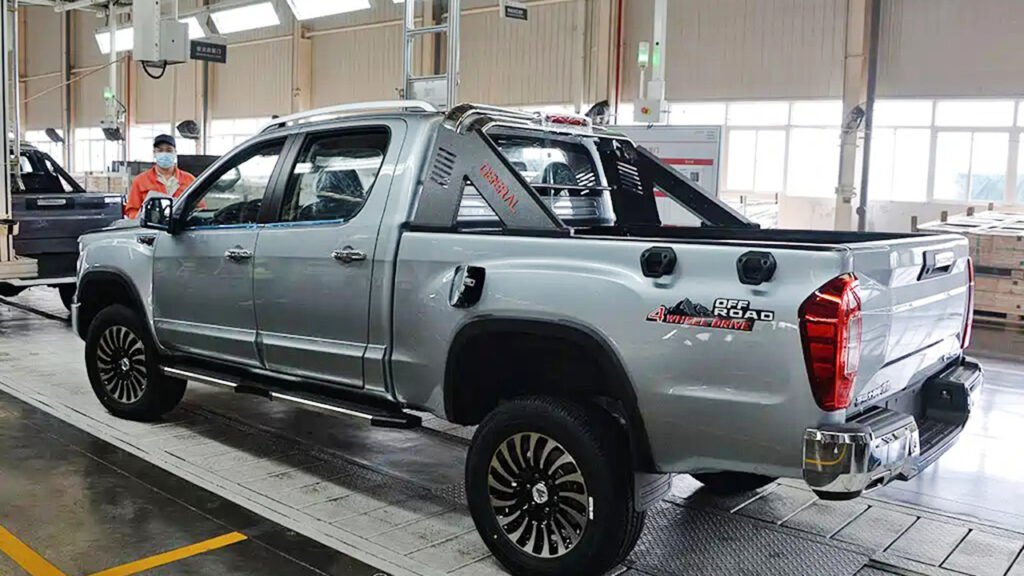
Key Features of Pickup Truck Assembly Lines
- High Adaptability for Heavy LoadsThe assembly line is equipped with reinforced conveyor systems (e.g., heavy-duty roller conveyors, suspension cranes) to bear the weight of the pickup’s frame and chassis, which is much higher than that of ordinary passenger cars. The assembly tools are also designed for heavy components, such as electric torque wrenches for large bolts connecting the frame and axles.
- Automation and Manual Operation IntegrationHigh-repetition, high-precision operations are completed by robots, such as the welding of frame beams, the installation of powertrain modules, and the gluing of windshield glass. Manual operations are focused on processes that require flexibility and judgment, such as the debugging of electrical systems, the adjustment of door and window gaps, and the inspection of component installation quality.
- Real-time Quality ControlEach station is equipped with quality inspection points. For example, after the frame is welded, a laser dimension detector will check its length, width, and straightness; after the brake system is assembled, a pressure test will be carried out to ensure no leaks. Unqualified components or semi-finished products will be marked and removed from the line for rework immediately, avoiding the flow of defects to subsequent processes.
- Modular Design for Multiple ModelsMost pickup assembly lines support mixed-line production of multiple models (e.g., standard cab, crew cab, short cargo box, long cargo box). By adjusting the fixture parameters and station processes, the line can quickly switch between different pickup configurations, improving production flexibility and market responsiveness.
Post-assembly Transfer Process
After the vehicle is fully assembled on the line, it will be transported to the testing area by a transfer vehicle. Here, it will undergo a series of tests (including safety performance, dynamic performance, emission testing, etc.) as mentioned in the previous testing process. Qualified vehicles will be sent to the storage yard for final inspection and delivery; unqualified vehicles will be returned to the rework area for targeted adjustments until they meet the standards.
Characteristics of a pickup truck Assembly Line
Find the Testing Line or Equipment for Your Needs. Get expert support—request a quote or let’s talk about your project.
Looking for VIN marking machines? Contact us for more information.
Need Filling Machines? Get expert support—request a quote or let’s talk about your project.
Looking for air compressors? Contact us for more information.
Need assembly tools or other auxiliary equipment? Contact us for more information.