

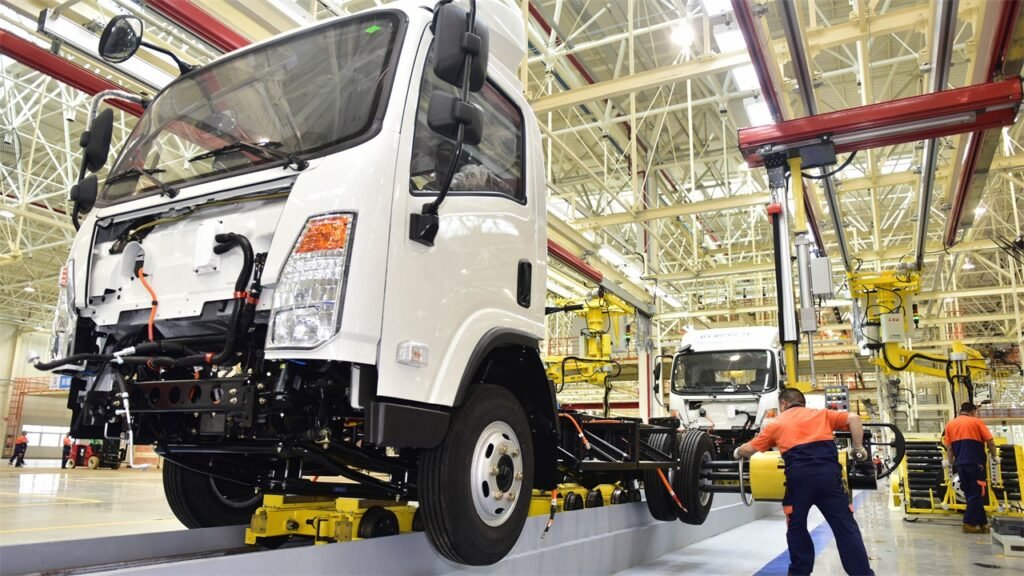
Light trucks have chassis (frame, transmission, etc.), body/cab (high-strength materials) and powertrain (diesel engines). Assembly covers frame, axle, engine and interior fitting. Testing includes safety, emission, structural strength checks. Light Truck Assembly lines are automated, modular, heavy-load adaptable with real-time QC, supporting multi-model production; vehicles are delivered post-test.
Light Truck Assembly Lines are suitable to Assemble/Produce light trucks. (If clients have more requirements or want to produce the other trucks, welcome to contact us.)
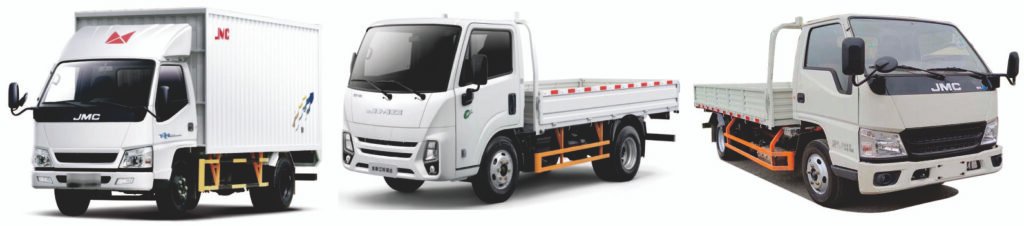
Part I. Structure, Assembly and Testing Processes of Light Trucks
Structure of Light Trucks
- Chassis: It consists of the frame, transmission system, running system, steering system and braking system. The frame serves as the core component, usually made up of longitudinal beams and cross beams. The suspension system generally adopts leaf spring suspension or air suspension.
- Body and Cab: The body is mostly made of high-strength steel or aluminum alloy materials to reduce weight and enhance load-bearing capacity. The cab is designed with ergonomics in mind, providing spacious space and safety features such as anti-collision structures and airbags.
- Powertrain: It includes the engine and transmission. Light trucks are commonly equipped with diesel engines, which feature good fuel economy and torque output, usually matched with manual or automatic transmissions.
Assembly Processes of Light Trucks
- Frame Assembly: It involves processes such as roll forming, CNC web punching, plasma cutting, bending and shot blasting, followed by quality inspection.
- Frame Wiring Harness and Brake Pipeline Arrangement: Route the frame wiring harness from the front to the rear of the vehicle. The brake pipelines are arranged inside the frame web and connected to components like brakes.
- Front and Rear Axle Sub-assembly and Assembly: Assemble front and rear axle components such as brake assemblies and shock absorber assemblies on the sub-assembly bench, then lift the entire assembly onto the production line and fasten the pins.
- Engine Installation: After the engine is sub-assembled on the sub-assembly line, lift it to the position of the frame cross beams for fixation, and connect the transmission and drive shaft.
- Interior Assembly: It includes the installation of in-vehicle wiring harnesses, pipelines, central control equipment, seats, carpets and other components.
- Other Assembly Work: Complete the connection of wiring harnesses and pipelines, and the assembly of small parts such as the cooling system, exhaust and urea systems, steering gear and fuel tank. Finally, carry out the assembly of doors and body, as well as vehicle debugging.
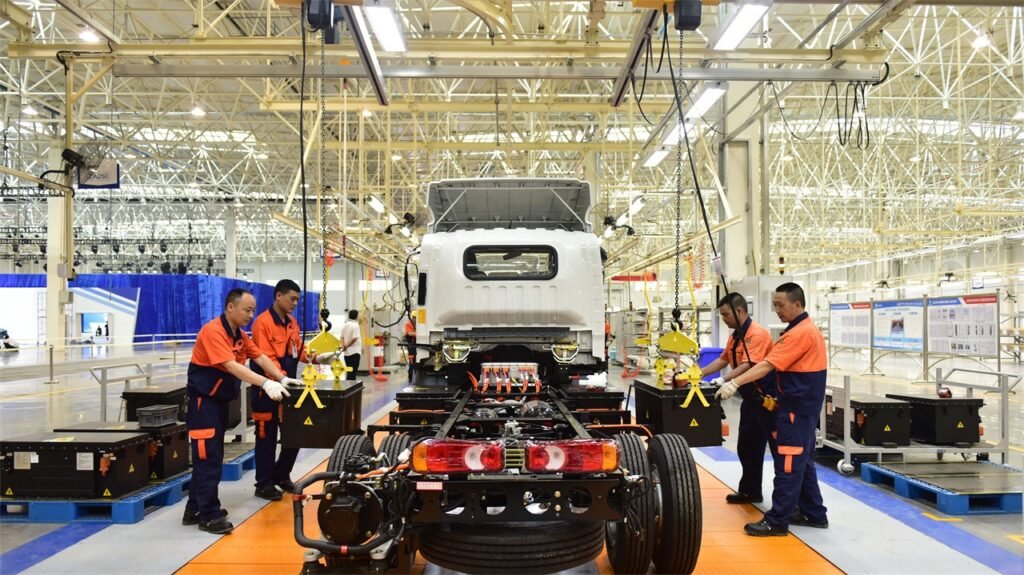
Testing Processes of Light Trucks
- Structural Safety Testing: Verify the integrity of frame welding through visual inspection and penetrant testing, and conduct load-bearing strength tests on the cargo box floor using the uniformly distributed load method.
- Powertrain Evaluation: Map the engine power output curve with a chassis dynamometer, and analyze the transmission system efficiency with a torque sensor.
- Emission Control Testing: Conduct exhaust gas sampling using the steady-state condition method, and verify the OBD system communication protocol with a CAN bus analyzer.
- Braking Performance Verification: Test the braking force distribution ratio with a roller brake tester, and measure the ABS/EBS response time with a pedal force trigger device.
- Electrical Equipment Inspection: Measure the wiring harness insulation resistance with a 500V megohmmeter, and test the light intensity distribution with a headlight tester.
- Special Additional Testing: For special-purpose models such as refrigerated trucks and engineering trucks, conduct corresponding special tests, such as the thermal insulation performance test of refrigerated truck boxes.
Part II. Explanation of Light Truck Assembly Line
Light truck assembly lines are large-scale automated production systems specifically designed for light commercial vehicles. Adopting the core model of “modular sub-assembly + flow-type final assembly,” they are tailored to the product characteristics of light trucks—balancing load-bearing capacity and flexibility—enabling efficient and standardized assembly from components to finished vehicles. Their overall layout and process configuration are designed around light trucks’ heavy-load requirements, multi-model adaptability, and compliance standards, consisting of four core functional areas and supporting quality control systems.
I. Core Composition of the Assembly Line
1. Pre-assembly & Sub-assembly Area
As a pre-final assembly process, this area is responsible for modular integration of key assemblies to reduce the complexity of main line operations:
- Chassis Core Sub-assembly: Complete precision verification and preprocessing of the frame (longitudinal + cross beam welded components), and simultaneously assemble front/rear axle assemblies (including brakes, wheel hubs, leaf spring suspensions), steering systems (steering gears, tie rods), and brake pipeline modules to ensure consistent assembly of critical load-bearing components.
- Powertrain Sub-assembly: Integrate diesel engines (mainstream displacement: 2.8-4.0L), transmissions, and drive shafts into an integrated module. Fasten connection points in strict accordance with torque standards, and complete pre-assembly of supporting cooling systems and intake/exhaust systems.
- Body Accessory Pre-assembly: Pre-install cab interiors (seats, instrument panels, wiring harnesses, air conditioning systems) and exteriors (doors, rearview mirrors, front dash panels). Meanwhile, conduct splicing and anti-corrosion treatment of cargo boxes (flatbed/van-type).
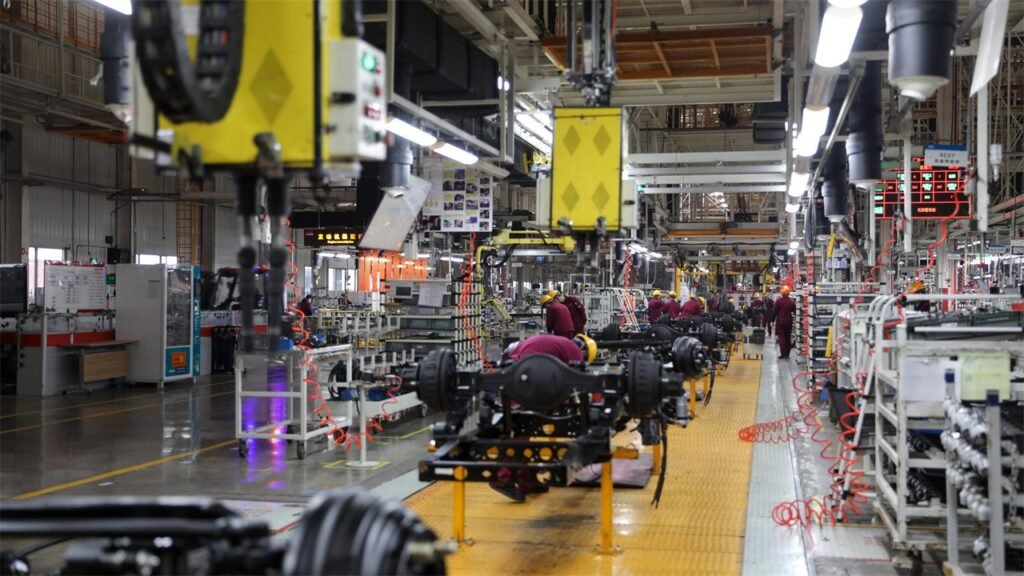
2. Main Assembly Line
As the core process of the assembly line, workpieces are transferred via conveying equipment (heavy-duty rollers, overhead conveyors) to achieve modular integration:
- Chassis Assembly Process: After the frame is put into production, sequentially hoist and install core components such as powertrain, front/rear axles, fuel tanks, urea tanks, and batteries. Complete wiring harness connection, brake pipeline installation, and hydraulic system pressurization, while conducting leak tests (fuel and brake pipelines) simultaneously.
- Body-Chassis Combination: Use high-precision lifting equipment to accurately hoist the pre-assembled cab onto the chassis frame, fixing it with locating pins and high-strength bolts to ensure connection rigidity. Subsequently, hoist the cargo box and complete flexible connection with the frame (shock absorber pad buffering).
- Final Assembly Process: Install accessories such as tires, fenders, vehicle lights, and license plate brackets. Fill engine oil, coolant, and brake fluid, and complete initial commissioning of the vehicle’s electrical system.
3. Final Assembly & Finishing Area
Focus on detail improvement and appearance finishing to meet delivery standards:
- Exterior Finishing: Clean surface stains, inspect paint integrity, adjust body gaps (between doors, cargo box, and cab), and attach identification plates.
- Interior Finishing: Clean the cab interior, verify the completeness of on-board tools, user manuals, and other accessories, and test the smooth operation of windows, air conditioning, audio, and other functions.
- Cargo Box Commissioning: For flatbed cargo boxes, check the flexibility of side panel opening/closing; for van-type cargo boxes, test door lock sealing and box flatness.
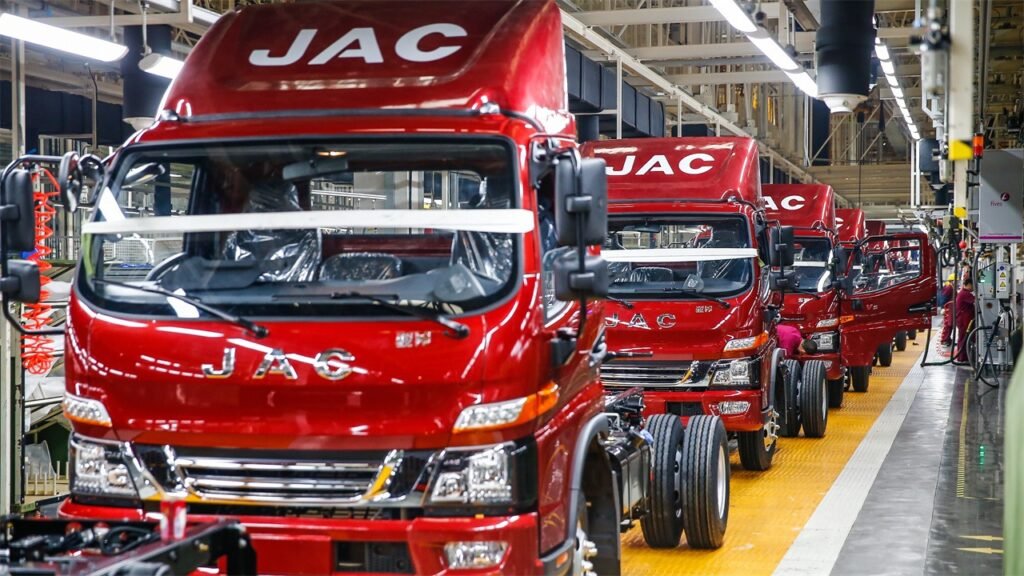
4. Off-line Testing Area
Connected to the end of assembly, conduct comprehensive performance verification (see core links of “testing processes” for details). Unqualified vehicles will be returned to the rework area for targeted rectification.
II. Core Process Characteristics
- Heavy-load Adaptability Design: Conveying systems and tooling fixtures are reinforced according to the full-load weight of light trucks, capable of bearing heavy components such as frames and cargo boxes. Assembly tools include heavy-duty electric torque wrenches and hydraulic lifting equipment, adapting to the tightening requirements of large-size bolts.
- Modular & Flexible Production: Supports mixed-line production of multiple models (different wheelbases, cargo box types, and power versions). By quickly switching fixture parameters and adjusting sub-assembly modules, it meets the assembly needs of special-purpose light trucks such as flatbeds, vans, and refrigerated trucks.
- Collaboration of Automation & Manual Operation: High-repetition, high-precision processes (e.g., frame welding, cab hoisting, pipeline sealing testing) are completed by robots; processes requiring flexibility (e.g., interior fine-tuning, electrical commissioning, gap adjustment) are mainly manual operations, balancing efficiency and accuracy.
- Full-process Quality Control: Inspection points are set at key stations (laser dimension measurement for frame accuracy, pressure sensors for bolt torque monitoring, air tightness testers for leak detection). Unqualified products are marked in real-time to avoid defect flow and ensure assembly consistency.
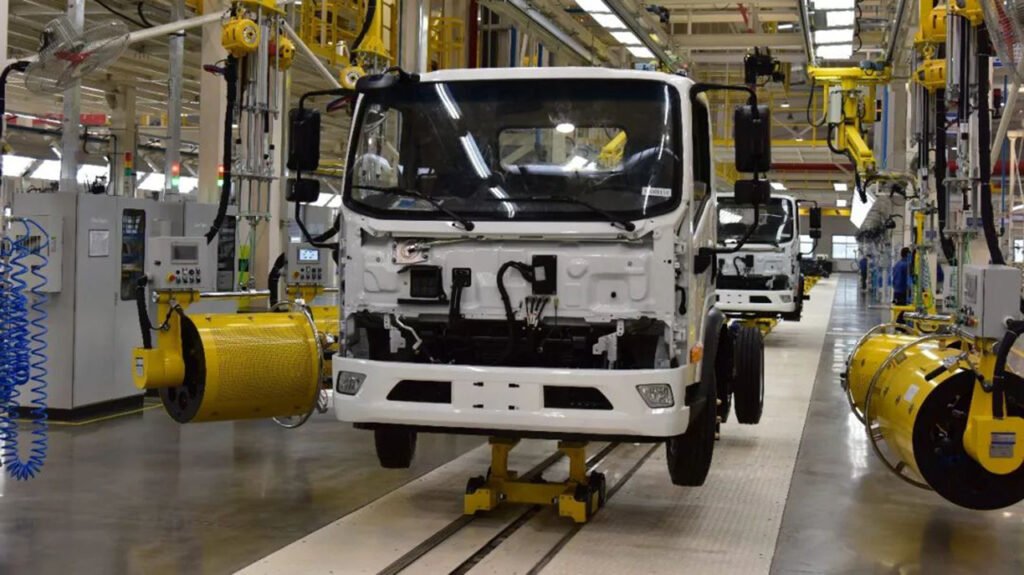
III. Core Links of Off-line Testing
- Safety Performance Testing: Roller brake tester for braking force distribution and ABS/EBS response time measurement; steering system clearance inspection.
- Power & Emission Testing: Chassis dynamometer for verifying engine power and torque; steady-state cycle method for exhaust emission testing (meeting National VI standards); OBD system function verification.
- Structural & Electrical Testing: Penetrant testing for frame welds; cargo box load-bearing strength testing; 500V megohmmeter for electrical system insulation resistance measurement; headlight tester for light distribution performance testing.
- Special Testing: For special-purpose models (e.g., refrigerated trucks), conduct thermal insulation performance testing of the box; for engineering light trucks, perform traction device strength verification.
Characteristics of a light truck Assembly Line
Find the Testing Line or Equipment for Your Needs. Get expert support—request a quote or let’s talk about your project.
Looking for VIN marking machines? Contact us for more information.
Need Filling Machines? Get expert support—request a quote or let’s talk about your project.
Looking for air compressors? Contact us for more information.
Need assembly tools or other auxiliary equipment? Contact us for more information.