

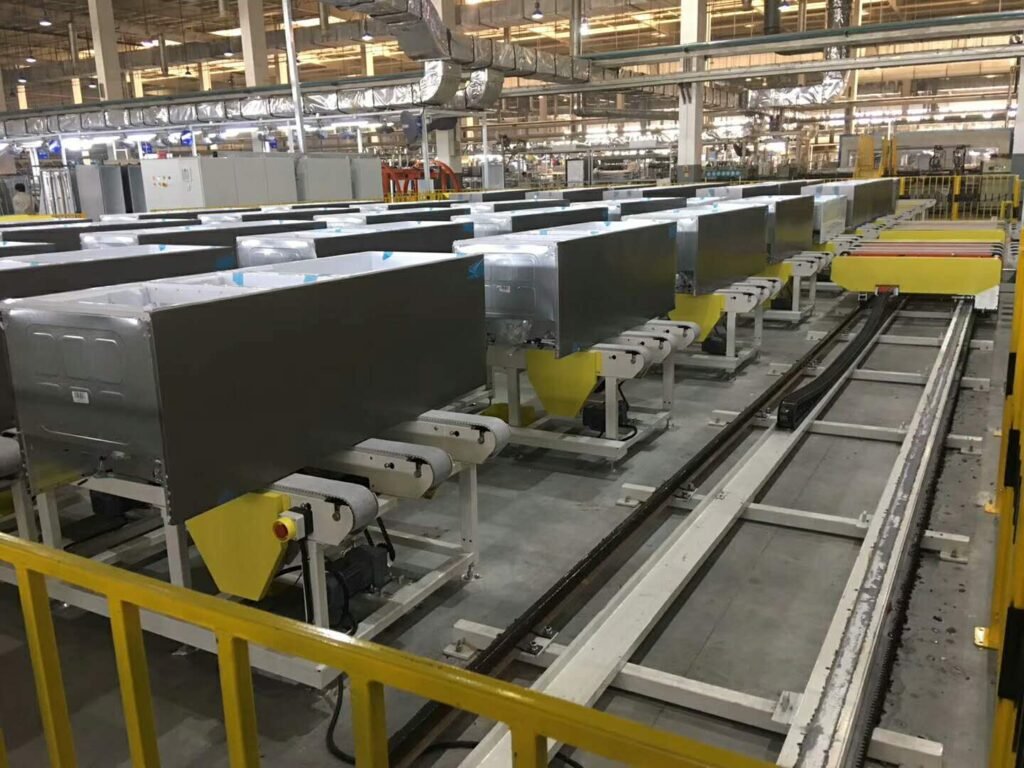
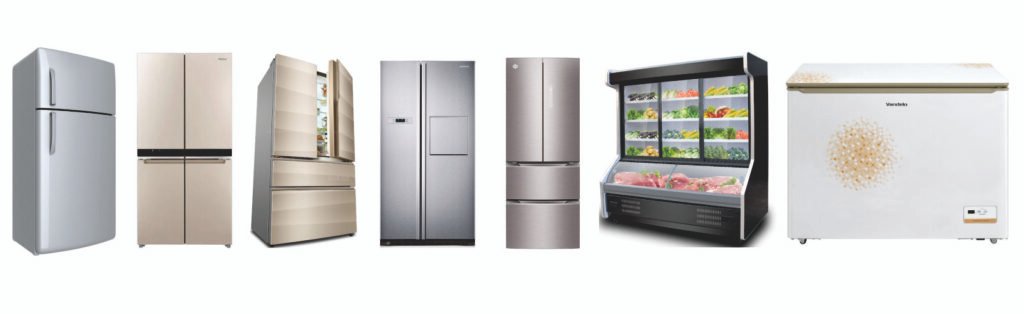
Fridge Assembly Lines/Production Lines are Suitable to Assemble/Produce Fridges.(Welcome to contact us, we will suggest and design the suitable Assembly Lines/Production Lines for you.)
1. Product and Process Characteristics
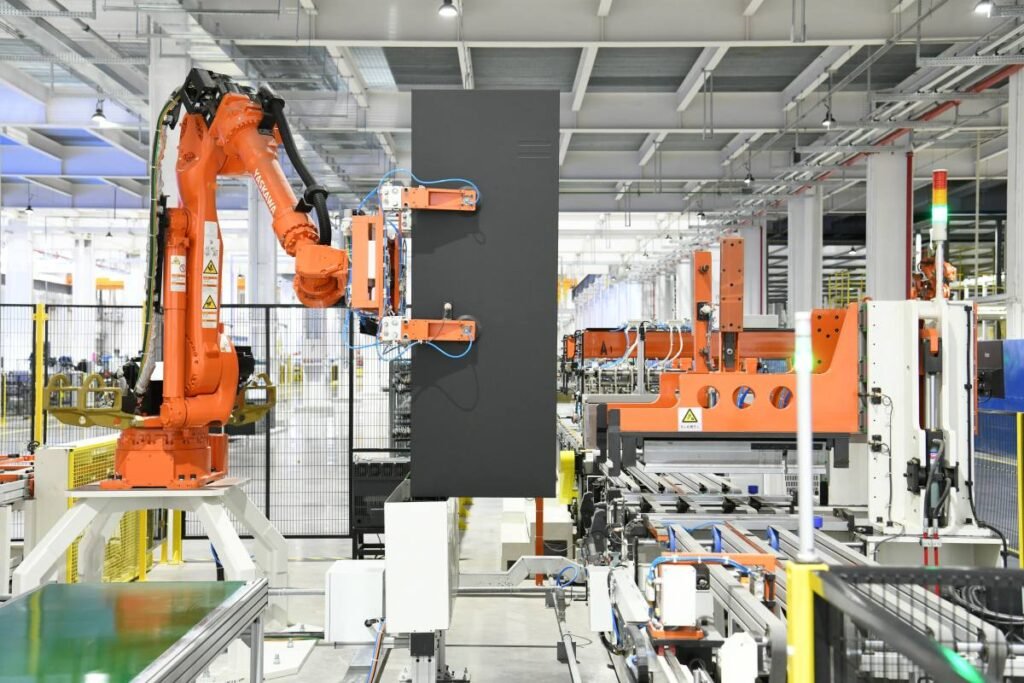
- Large Product Size and Weight: Refrigerators are large white goods, which necessitates ample space and high load-bearing capacity in the production line. Material handling (e.g., cabinets, doors) typically relies on automated equipment (such as robotic arms, AGVs) or heavy-duty conveyor lines.
- Mixed-Model Production: A single line usually needs to flexibly adapt to refrigerators of different capacities, models (single-door, double-door, French door, multi-door), colors, and functions, placing high demands on production line flexibility.
- Complex and Fixed Assembly Sequence: The process is strict and sequential, generally comprising: Inner Liner Pre-assembly → Foaming (Core Process) → Door Pre-assembly → Final Assembly (Installing compressor, condenser, wiring, etc.) → Testing → Packaging. The foaming process is a unique, critical step requiring isolated, sealed stations and curing time.
- High Precision and Cleanliness Requirements: This is especially true for the refrigeration system and electrical assembly, demanding extremely high standards for sealing (preventing refrigerant leaks), cleanliness (preventing clogging), and electrical safety.
2. Production Line Technical Features
- High Degree of Automation Combined with Semi-Automation:
- Fully Automated Stages: Common for repetitive, high-precision, or harsh environment tasks, e.g., robotic glue dispensing, robotic cabinet/door handling, automated compressor loading, robotic palletizing.
- Semi-Automated/Manual Stages: Many tasks like wire harness connection, component assembly, visual inspection, and functional testing still rely on skilled workers due to flexible cables, complex judgment, and dexterous operations.
- Conveyor-Line-Centric Flow Layout: Typically using slat chain, roller, or overhead suspension conveyors to link various functional stations (e.g., foaming station, vacuum and charging station) into a continuous or pulsed flow.
- Modular and Flexible Design: Jigs and fixtures can be changed quickly to accommodate different models. The control system can identify different products and call up corresponding programs for “mixed-model production.”
- Informatization and Data Integration (Industry 4.0): This is the core feature of modern advanced assembly lines.
- MES (Manufacturing Execution System): Tracks each production order, manages production pace, collects data on labor hours and quality.
- RFID/Barcode Technology: Each refrigerator or pallet has a unique identifier, enabling full-process traceability. Scanning tells workers what parts to install and what parameters to set.
- Real-time Monitoring & Data Analysis: Monitors key process parameters (e.g., foaming temperature/pressure, refrigerant charge amount) for quality alerts and predictive equipment maintenance.
3. Production Management Characteristics
- Strict Takt Time Management: The line operates on a fixed production cycle time (Takt Time). All operations must be completed within this time to ensure overall output efficiency.
- High Supply Chain Coordination Demand: Refrigerators consist of numerous components (hundreds), involving sheet metal, plastics, motors, compressors, electronic parts, etc. This requires an efficient material delivery system (e.g., SPS kit supply or Kanban) to ensure parts arrive at the line side just-in-time and accurately.
- Quality Control Integrated Throughout: Quality inspection is not just a final step but embedded in each key stage: leak testing after foaming, electrical safety testing after assembly, final performance testing (including cooling, noise, energy consumption). All data is recorded and linked to the product serial number.
- Focus on Energy Consumption & Environmental Protection: The production line itself consumes energy while also producing high-efficiency products. Refrigerant charging must comply with environmental regulations, and waste (e.g., foam waste) requires specialized handling.
4. Unique Core Process Stages
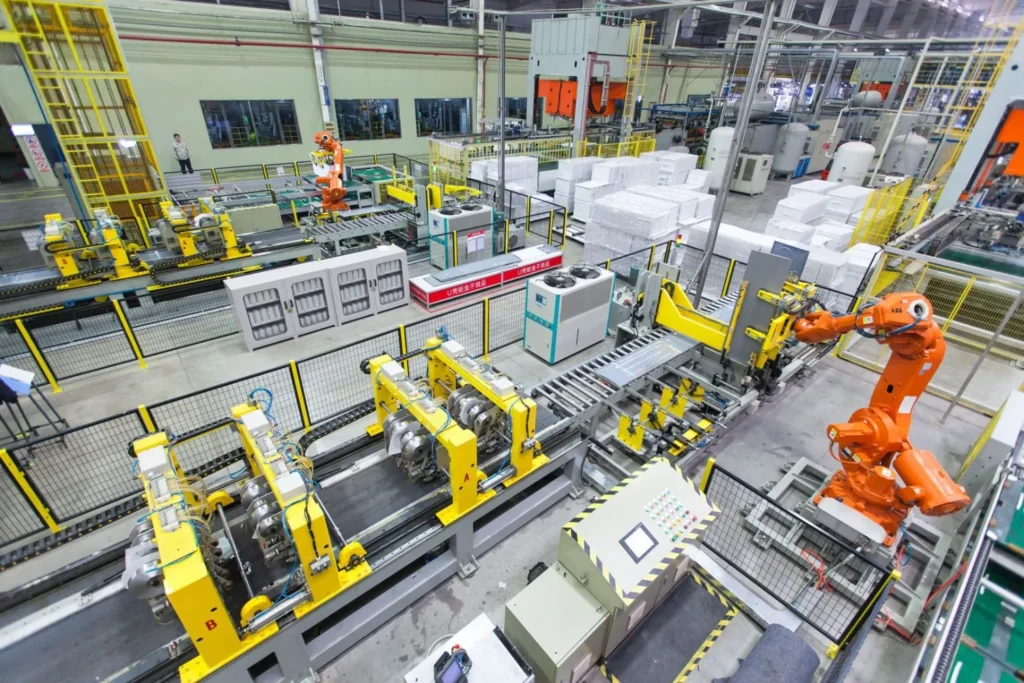
- Cabinet/Door Foaming: This is the “heart” of refrigerator manufacturing. Liquid polyurethane is injected into the cavity between the inner and outer liners, where it rapidly expands and cures within a mold to form the insulation layer. This process requires dedicated high-pressure foaming machines, molds, and curing lines, with precise control over temperature, pressure, chemical formulation, and time.
- Refrigeration System Assembly & Testing: Includes compressor welding, tubing connection, vacuum evacuation, refrigerant charging, etc. It has stringent requirements for sealing and cleanliness, typically involving dedicated stations for nitrogen leak testing, refrigerant charging, and re-inspection.
Summary
The core characteristic of a modern refrigerator assembly line is: achieving high-volume, high-efficiency production while simultaneously meeting the complex demands of multi-variety, high-quality, and traceable manufacturing through a high degree of automation, informatization, and flexibility. It has evolved from a simple mechanical conveyor belt into a comprehensive smart manufacturing system integrating mechanical engineering, automation control, information technology, and supply chain management, serving as an excellent window into advanced manufacturing.