

A belt conveyor is a continuous conveying machine that uses a conveyor belt for carrying and traction. Driven by a motor and rollers, it transports materials, workpieces and products smoothly.
It consists of a belt, drive unit, frame, rollers, tension device and accessories. Features include stable operation, low noise, adjustable speed and easy maintenance. It can be horizontal, inclined or curved.
Widely used in electronics, food, logistics, packaging and assembly lines, it is suitable for light industry, food processing, warehouse sorting and other fields.
Description and Introduction
1. Basic Introduction
Belt conveyor (referred to as belt line) is a type of continuous conveying equipment. It uses a conveyor belt as the carrying and traction component, driven by a motor and rollers to circulate the belt, enabling smooth transportation of materials, workpieces and products. It is the most common and basic conveying equipment used in automated assembly lines, logistics and production workshops.
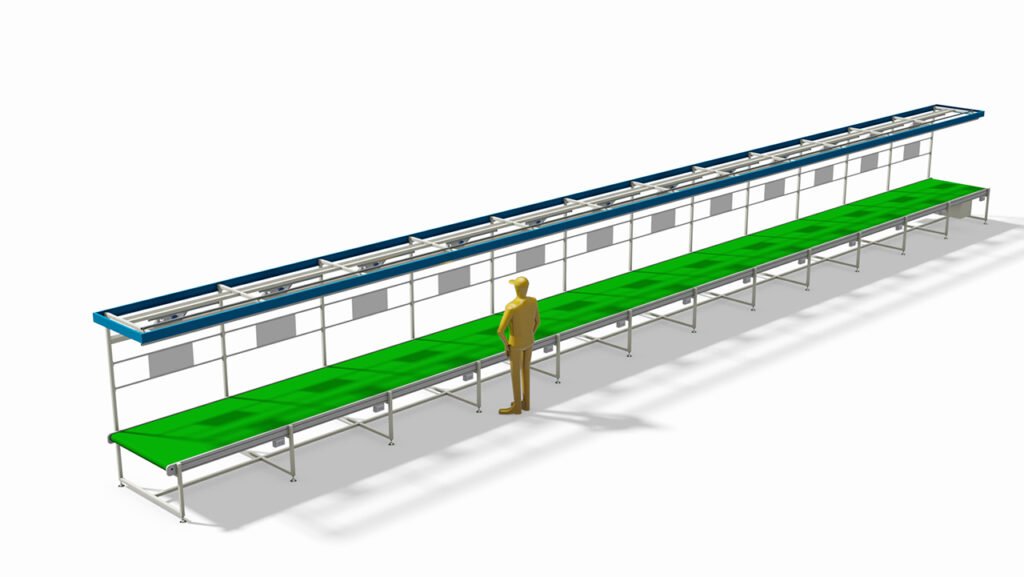
2. Main Structure
- Conveyor Belt
- Common materials: PVC, PU, rubber, silicone, food-grade belt, etc.
- Function: Carries materials and transmits power.
- Drive Unit
- Motor + gearbox / motorized pulley
- Provides power to drive the belt.
- Frame
- Materials: Aluminum alloy, carbon steel with painting, stainless steel.
- Supports the entire conveyor line.
- Rollers / Idlers
- Drive roller, driven roller, support roller.
- Tensions, guides and supports the belt.
- Tension Device
- Adjusts belt tightness to prevent slipping and deviation.
- Auxiliary Parts
- Guardrails, baffles, speed controller, adjustable feet, joints, positioning blocks, etc.
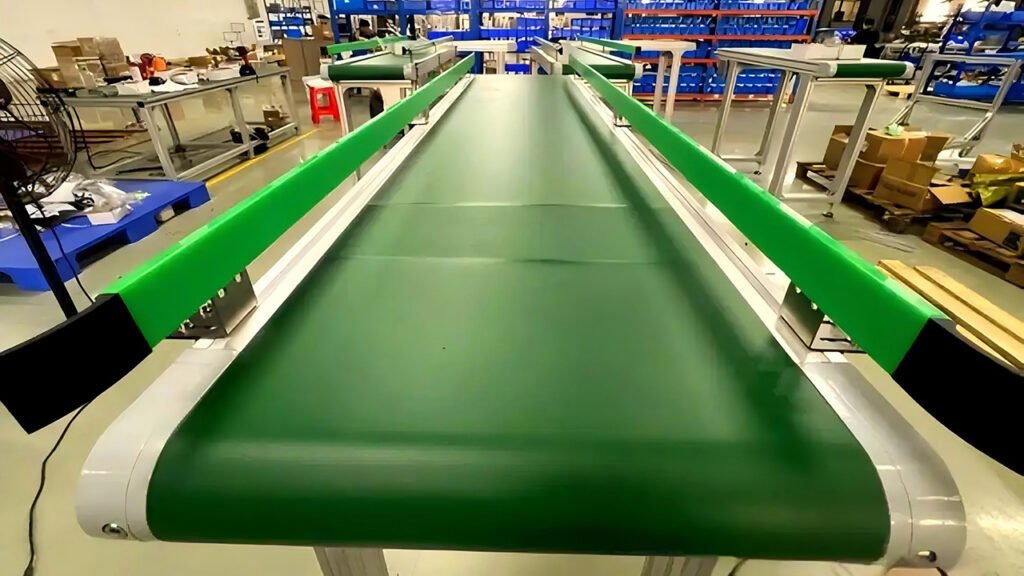
3. Working Principle
The motor drives the drive roller to rotate → friction is generated between the roller and the belt → the belt moves cyclically → materials placed on the belt are conveyed forward with the belt.
4. Features and Advantages
- Stable operation, avoiding material tipping, collision and damage.
- Low noise, suitable for workshops, warehouses and clean environments.
- Supports horizontal, inclined and curved conveying.
- Adjustable speed (variable frequency / speed control).
- Simple structure, easy maintenance and low cost.
- Can connect with assembly lines, packaging machines, sorters and worktables.
- Can be designed as straight, curved, inclined, lifting, circular and other forms.
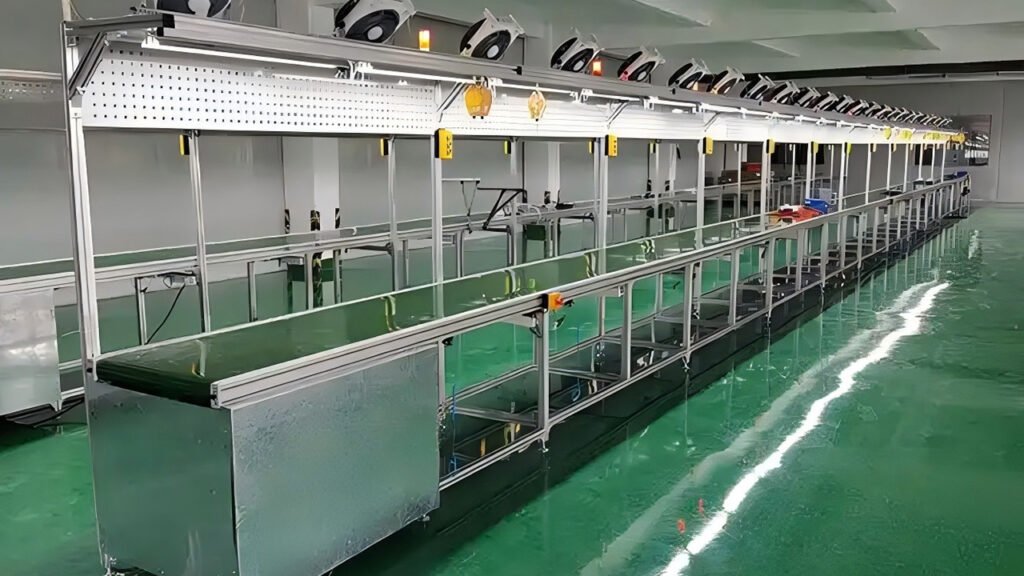
5. Common Classifications
- Light-duty Belt Conveyor: For electronics, light industry, packaging, small-piece logistics.
- Heavy-duty Belt Conveyor: For bulk materials such as mining, coal, sand, grain.
- Food-grade Belt Conveyor: For food, beverage, pharmaceutical, fruit and vegetable processing.
- Curved Belt Conveyor: 90° and 180° turning for circular assembly lines.
- Inclined Belt Conveyor: With baffles / skirts to prevent material sliding.
- Anti-static Belt Conveyor: For electronic workshops, PCB and electronic product assembly.
6. Application Scope
- Assembly lines for electronic appliances, hardware, plastics, toys, etc.
- Processing and packaging conveying for food, beverage, medicine, fruits and vegetables.
- Sorting, packing and loading/unloading for e-commerce, express delivery and warehouses.
- Material transfer, production line connection and feeding/discharging in workshops.
- Long-distance bulk material conveying in mining, building materials, grain industries, etc.
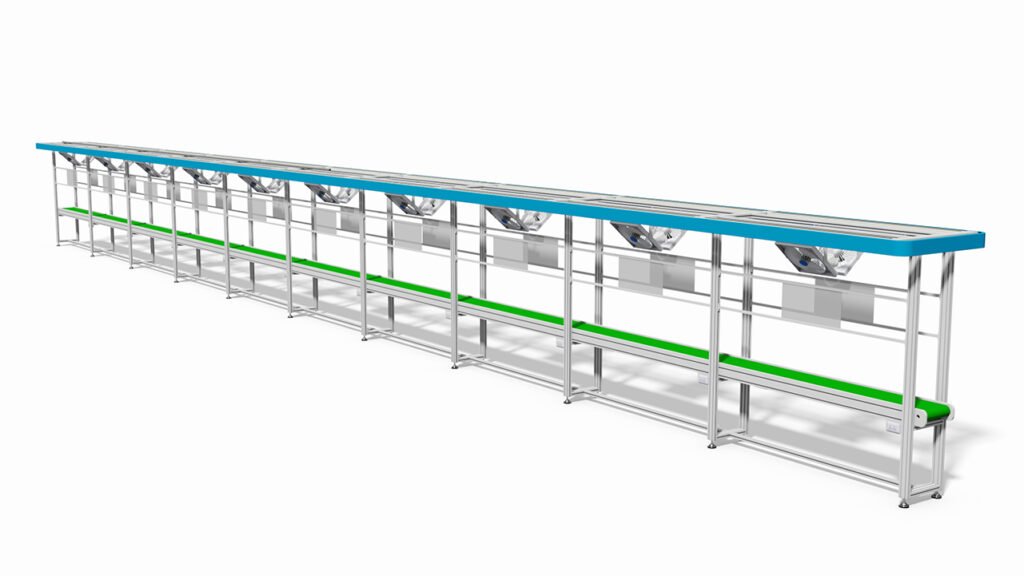
We can customize according to the client’s product specifications, production capacity or other requirements.
We provide comprehensive services including design, production, and installation/commissioning.