

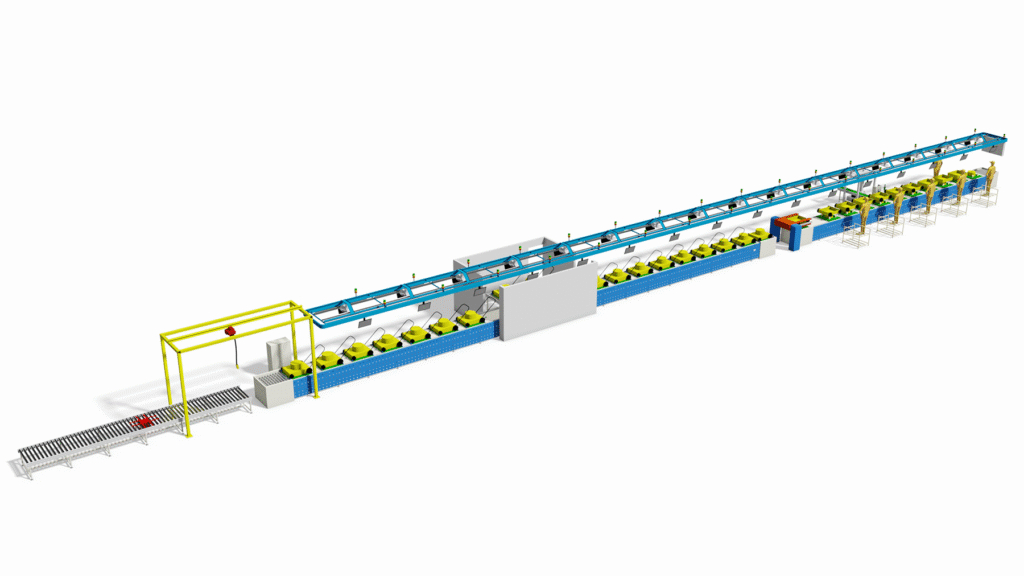
Electric mower Assembly lines resemble electronics production: modular, automated, focused on electrical safety. Key work: battery/motor/controller integration, wiring, electrical testing. Environment: anti-static, clean. Skills: basic electrical knowledge.
Gas mower Assembly lines follow engine manufacturing logic: mechanical assembly, fluid handling. Key work: engine mounting, belt tensioning, oil/fuel filling. Lower automation, relies on skilled labor. Environment: ventilated, oil-resistant. Skills: mechanical adjustment, engine troubleshooting. Testing differs: electric focuses on circuitry; gasoline on engine performance/emissions.
Mower Assembly Lines are suitable to Assemble/Produce Mowers. (If clients have more requirements or want to produce the other Mowers, welcome to contact us.)
Part I. Electric Lawn Mowers vs. Push Mowers: Structural Differences
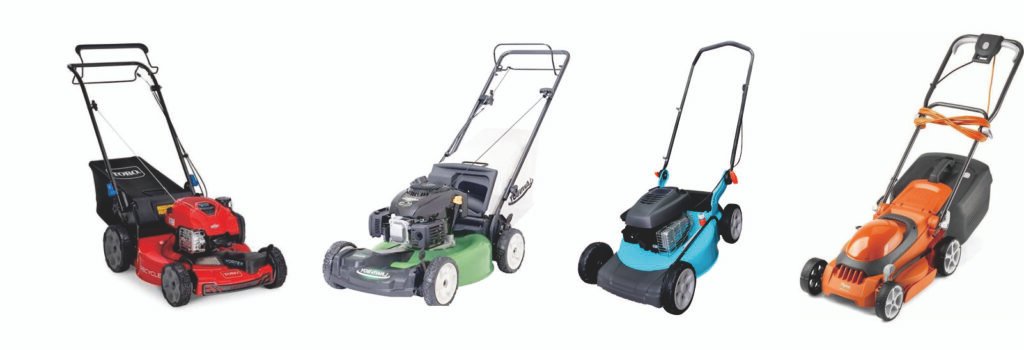
Electric lawn mowers and push mowers are both common household tools for lawn maintenance, but they differ significantly in their operating principles and structure. Simply put, “push-type” emphasizes human-powered movement, while “electric” emphasizes electricity as the cutting power source. These two categories are not entirely mutually exclusive, as “electric push mowers” also exist in the market.
1. Core Definitions
- Push Lawn Mower: Generally refers to a mower that relies on human pushing to move forward. Its cutting power can be human-powered (reel blade), gasoline engine, or electric motor. When people refer to a “push mower,” the focus is typically on its lack of self-propulsion.
- Electric Lawn Mower: Generally refers to a mower that uses electricity as the cutting power source. Its movement can be human-powered (push-type) or motor-driven (self-propelled). It is further divided into corded and battery-powered (cordless) types.
For a clearer comparison, we will use the two most common combinations as examples: Electric Push Mower vs. Gasoline Push Mower.
2. Main Structural Differences
| Structural Component | Electric Push Mower (Battery/Corded) | Traditional Gasoline Push Mower |
|---|---|---|
| 1. Power System | ||
| Power Source | Electric Motor | Gasoline Internal Combustion Engine |
| Energy Storage/Supply | Battery Pack (rechargeable lithium battery) or Power Cord (connected to mains power). The battery is usually placed on the top or rear of the mower. | Fuel Tank (stores gasoline) and a Small Battery (for electronic ignition). |
| Starting Method | Very simple, usually a one-button switch start, silent or low-noise startup. | Requires pull-cord starting (recoil starter), may require multiple pulls, with noticeable noise and vibration. |
| Exhaust & Cooling | No exhaust emissions. The motor generates little heat during operation, and the cooling structure is simple. | Equipped with an exhaust pipe and muffler, emitting exhaust gases. Requires air-cooling or forced cooling systems, and the mower body generates significant heat. |
| 2. Cutting System | ||
| Blade Drive | The motor shaft drives the blade directly or via a belt for high-speed rotation. | The engine crankshaft drives the blade via a belt or directly for high-speed rotation. |
| Blade Type | Mostly a single suspended rotary blade (similar to a fan blade), with a relatively simple structure. | Also mostly a single suspended rotary blade, but requires sturdier connections to withstand engine vibration and torque. |
| 3. Mobility System | ||
| Movement Drive | Pure human pushing. The wheels are typically not power-connected and roll based on user pushing. Some high-end models have a “self-propelled” function (additional motor drives the wheels). | Pure human pushing. The wheels are disconnected from the engine via gears or belts and only roll freely. |
| Wheels | Usually plastic or rubber wheels, which may be smaller in size. | Usually larger, sturdier rubber wheels to accommodate the heavier body and more complex terrain. |
| 4. Body & Controls | ||
| Body Structure | Relatively lighter, more compact, with fewer components (no fuel tank, air filter, complex exhaust system). | More complex and heavier in structure, containing various components like fuel tank, air filter, spark plug, and oil dipstick. |
| Control Devices | Simple control panel: main power switch, safety start handle (stops when released), battery charge indicator. | More control devices: throttle control, choke (for cold starts), engine kill switch, etc. |
| Grass Collection/Side Discharge | Similar function, with adjustable grass bag connectors or side-discharge/mulching plugs. | Similar function, but due to generally higher power, the grass collection capacity may be larger. |
| 5. Maintenance & Safety | ||
| Routine Maintenance | Minimal maintenance: almost only requires cleaning and keeping the blade sharp. The battery needs to be charged and stored according to instructions. | Complex maintenance: requires regular oil changes, air filter replacement, spark plug checks, fuel management, carbon deposit handling, etc. |
| Safety Features | Usually features dual safety switches (main switch + operator presence control). Operating noise is very low, with no hot surfaces (except near the motor). | High noise levels, requiring hearing protection. The exhaust pipe and engine block remain hot for a long time after operation, posing a burn risk. |
3. Summary and Selection Guide
Core Characteristics of Electric Lawn Mowers (Push-Type):
- Advantages: Quiet, zero emissions, extremely easy to start and maintain, lightweight body.
- Disadvantages: Limited runtime (for battery models, depends on battery capacity and lawn conditions), relatively lower power (may struggle with tall, thick grass), corded models are limited by power cord length and safety.
Core Characteristics of Gasoline Push Lawn Mowers:
- Advantages: Strong and continuous power, no runtime limitations, suitable for large areas, overgrown, or sloped lawns.
- Disadvantages: High noise and air pollution, complicated maintenance, more effort to start, heavy body, higher operating costs (need to purchase gasoline and oil).
How to Choose:
- Lawn Area and Condition: For small to medium-sized (<500 sq.m), relatively flat lawns, an electric model is sufficient. For large areas, complex terrain, or tough grass, a gasoline mower is more reliable.
- User Experience Preference: If you value quiet operation, cleanliness, and ease of use, choose electric. If you don’t mind maintenance and noise and prioritize raw power, choose gasoline.
- Storage and Charging Conditions: If you have a convenient place to charge and store batteries, choose electric. If you have a safe, well-ventilated place to store gasoline, you can consider a gasoline model.
Part II. Electric Lawn Mowers vs. Push Mowers: differences in assembly and testing processes
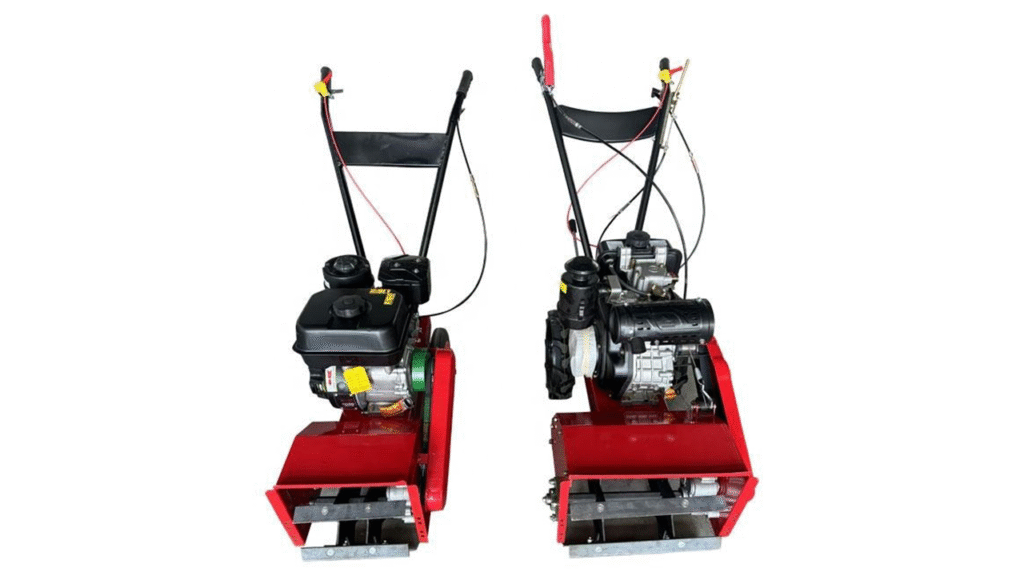
In summary, the assembly of electric mowers is more modular and automated, with testing focused more on electrical safety and battery management systems; whereas gasoline push mower assembly leans more towards mechanical precision, with testing focused more on engine performance and emissions.
Below is a detailed analysis of the differences in their assembly and testing processes:
I. Assembly Process Differences
Electric Lawn Mower (Battery-Powered Push Type) Assembly Characteristics:
- High Degree of Modularity:
- Core Three Modules: Battery pack, motor (including controller), chassis (including wheel set). These modules are typically pre-assembled on sub-assembly lines and then quickly joined on the main assembly line.
- Simplified Assembly Actions: The motor is mostly installed as a complete unit, connected to the controller and switches via connectors, eliminating complex mechanical adjustments.
- Higher Proportion of Automated Assembly:
- Screw fastening (especially at critical safety points) uses electric torque screwdrivers with torque data logging to ensure consistency.
- The connection of the battery pack to the host machine and circuit checks can be performed using automated equipment for plugging/unplugging and continuity tests.
- The assembly of motor stators and rotors, and the soldering of controller boards (SMT) are already highly automated at the supplier level.
- High Cleanliness Requirements (Clean Environment):
- Electrical components, especially the controller (PCB board) and sensors, are sensitive to dust and static electricity. The assembly line requires anti-static measures and a relatively clean environment.
- Wiring Harness Assembly is a Key Station:
- The main control board, safety switches, start handle switch, battery interface, etc., must be reliably connected via the wiring harness. The routing, securing, and waterproofing (if applicable) of the harness are critical process points.
Push-Type Gasoline Lawn Mower Assembly Characteristics:
- Engine-Centric Mechanical Assembly:
- The assembly line typically begins with mounting the engine assembly onto the chassis. The engine itself is a complex pre-assembled unit.
- Subsequent work revolves around the engine: installing the pulley, air filter, muffler, throttle cable, fuel tank, etc.
- Multiple Mechanical Adjustment and Calibration Stations:
- Transmission System Adjustment: Requires installing and adjusting the belt tension that drives the blade. This is a critical station directly affecting cutting efficiency and belt life.
- Control System Adjustment: The installation of throttle and kill switch cables needs adjustment to the appropriate tightness to ensure flexible operation and complete engine shut-off.
- Carburetor Pre-adjustment: Although the carburetor is part of the engine assembly, it may require preliminary adjustment before final machine testing.
- Involves Fluid Handling Stations:
- Oil Filling Station: A dedicated station for filling the engine with a specified amount of oil.
- Fuel Filling for Testing: A small amount of fuel is added before testing for startup and testing purposes.
- These stations require leak prevention measures and environmental considerations.
- High Sealing Requirements:
- The sealing integrity of fuel lines, fuel tank cap, oil fill port, etc., must be guaranteed. Assembly requires checking if seals are properly seated and fastenings are appropriate.
II. Testing Process Differences
This is the area where the differences are most pronounced.
Electric Lawn Mower Testing Focus:
- Electrical Safety Testing (Mandatory, Primary):
- Insulation Resistance Test: Measures the insulation resistance between live parts and accessible metal parts, which must comply with safety standards.
- Withstand Voltage Test (High-Potential Test): Applies high voltage (e.g., 1500V-3000V AC) to verify insulation strength.
- Earth Continuity Test (for Class I appliances): Ensures the grounding path resistance is sufficiently low.
- Leakage Current Test.
- Battery and Battery Management System (BMS) Testing:
- Battery Pack Function Test: Checks if communication between the battery and host is normal and if the charge indicator is accurate.
- Charge/Discharge Protection Test: Simulates conditions like overcharge, over-discharge, short circuit, overheating to verify if BMS protection functions are triggered immediately.
- This is core to the safety of electric tools, and testing is very stringent.
- Control Logic and Function Testing:
- Safety Interlock Test: Verifies that the logic requiring simultaneous pressure on the safety handle and start switch for startup, and immediate shutdown upon releasing either, is correct.
- Switch Life Test (sampling): Performs frequent on/off cycle life tests on switches.
- Locked Rotor Test: Simulates blade jamming to check if the motor’s overcurrent protection activates.
- Complete Machine Run Test:
- Runs unloaded on a test bench, listening for smooth motor operation and any abnormal noises.
- Checks if vibration is within an acceptable range.
- Testing duration is relatively short as no “warm-up” is needed.
Push-Type Gasoline Lawn Mower Testing Focus:
- Specialized Engine Performance Testing:
- Starting Performance Test: Pull-cord start, verifying if it can start successfully within a specified number of pulls.
- Idle Stability Test: After starting, observes if the idle speed is steady without stalling.
- High/Low Speed Operation Test: Tests engine response when moving the throttle from low to high speed, checking for sensitivity, smoothness, abnormal stalling, or speed fluctuation.
- Ignition System Test: Checks spark plug ignition condition.
- Fuel System and Seal Integrity Testing:
- Fuel Leak Test: Tilts the complete machine at various angles to check for leaks from the fuel tank, fuel lines, or carburetor.
- Pressure Test: Performs seal integrity tests on components like the fuel tank cap.
- Emission and Noise Testing (Sampling or 100% inspection, depending on regulations):
- Emission Test: Uses an exhaust gas analyzer to measure if pollutants like CO and HC meet standards.
- Noise Test: Measures operating noise at specific distances and positions to ensure compliance with regulatory limits.
- Mechanical Transmission and Cutting Testing:
- Transmission Test: Applies load on a test bench, observing if belt drive is smooth without slippage or abnormal noise.
- Cutting Effect Simulation (possibly sampling): Tests actual cutting performance using grass bundles in a testing area to see if it’s clean and efficient.
- Vibration Test: Measures vibration values at the handle and other positions to assess operator comfort.
Conclusion: The assembly and testing processes for electric lawn mowers are closer to those of “consumer electronics” or “power tools,” being cleaner, quieter, and more automated. In contrast, the processes for gasoline lawn mowers are closer to “small general-purpose machinery,” emphasizing mechanical precision, fluid sealing, and combustion power tuning. This fundamental difference dictates significant variations in production line layout, equipment investment, and skill requirements.
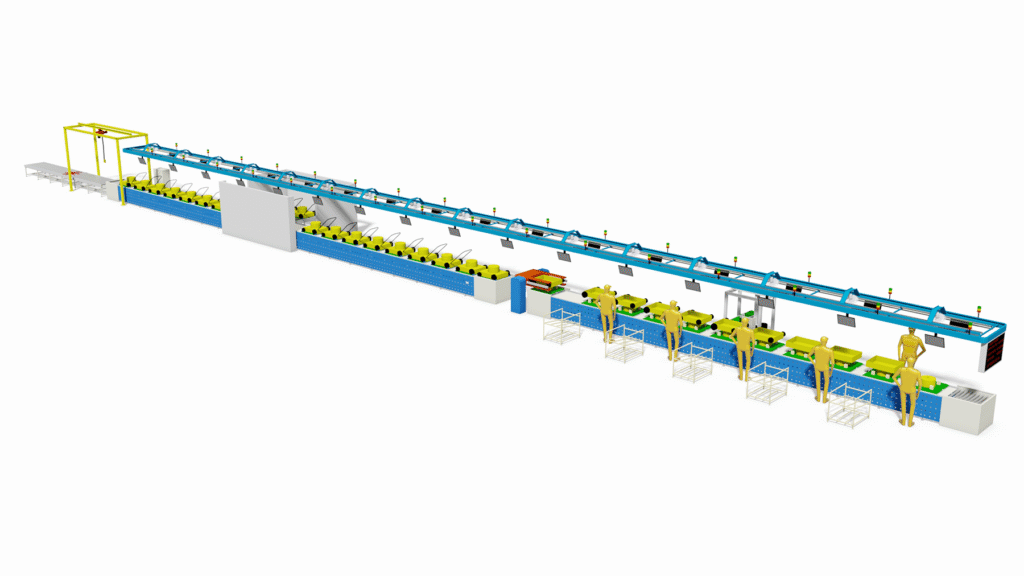
Part III. Electric Lawn Mowers vs. Push Mowers: differences in assembly lines
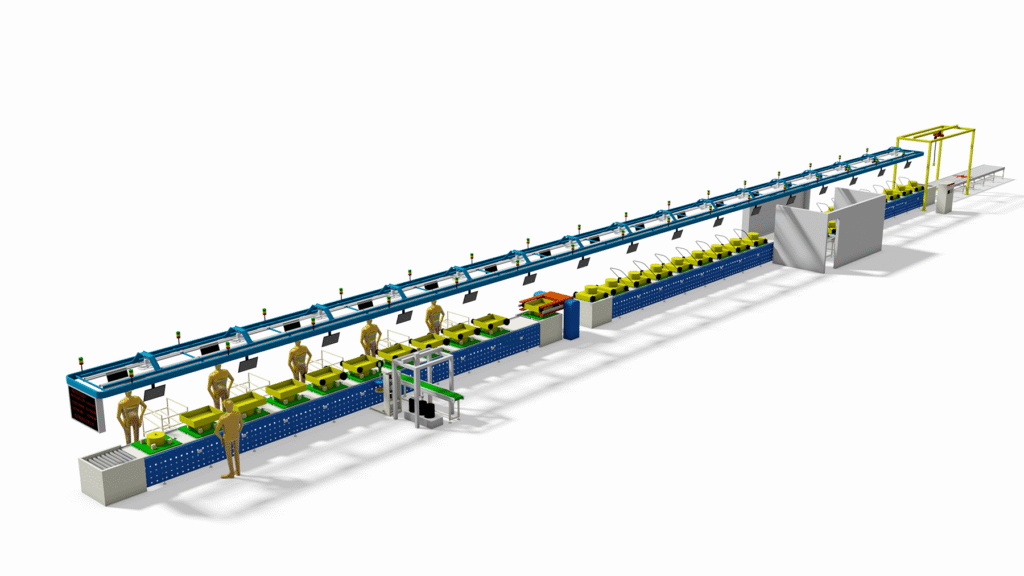
Differences Between Electric Lawn Mower Assembly Lines and Push Mower Assembly Lines
This is a core question about production line design. The differences between assembly lines for electric lawn mowers and push-type gasoline lawn mowers stem from fundamental distinctions in product structure, process priorities, and testing requirements.
In simple terms, electric lawn mower assembly lines resemble those for electronics or power tools, emphasizing modularity, automation, and electrical safety; whereas push-type gasoline lawn mower assembly lines are closer to those for small internal combustion engines, focusing on mechanical assembly, fluid handling, and performance calibration.
The following provides a detailed comparison of the two assembly lines across seven core dimensions:
Core Differences: Electric Lawn Mower vs. Push-Type Gasoline Lawn Mower Assembly Lines
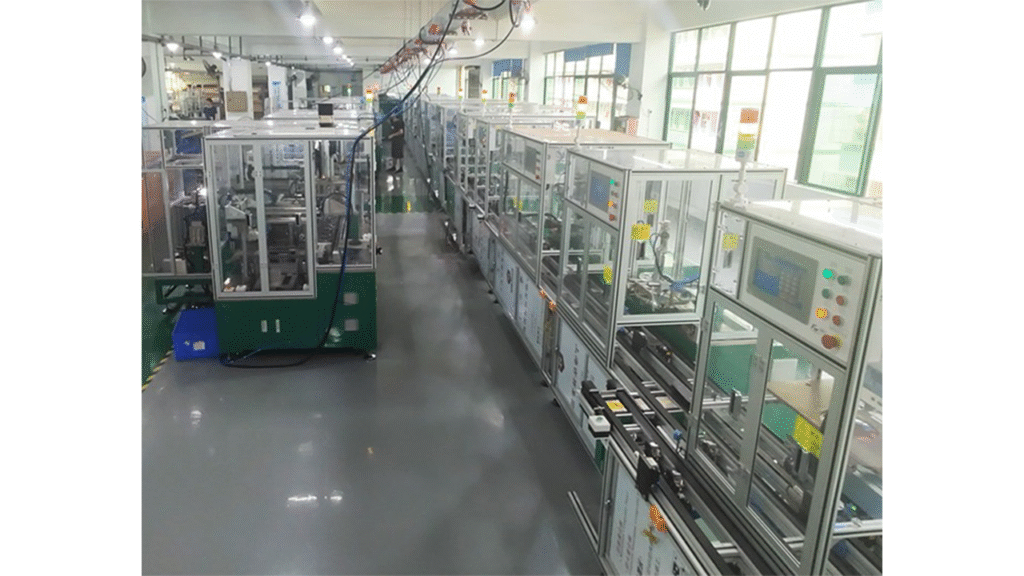
| Comparison Dimension | Electric Lawn Mower (Battery) Assembly Line | Push-Type Gasoline Lawn Mower Assembly Line |
|---|---|---|
| 1. Line Layout & Pace | Modular assembly line with relatively concentrated workstations. Fast-paced with short cycle times. Due to fewer parts and simpler assembly, the line may be shorter in length. | Branching assembly line centered on engine installation. Typically includes an engine pre-assembly/testing sub-line that merges into the main line. Slower-paced with longer cycle times due to mechanical adjustments and fluid filling. |
| 2. Core Workstations & Content | Key Workstations: • Electrical Module Integration: Connecting and securing the battery pack, controller, and motor. • Wiring Harness Assembly & Testing: Ensuring all electrical connections are reliable. • Electrical Safety Testing Station (in-line or at the end). | Key Workstations: • Engine Hoisting & Mounting: Installing the heavy engine onto the chassis. • Transmission System Adjustment Station: Installing and tensioning the drive belt. • Fluid Filling Station: Adding engine oil and fuel. • Control Linkage Adjustment Station: Adjusting throttle and kill switch cables. |
| 3. Level of Automation | Higher degree of automation. • Extensive use of automatic screwdriving machines (especially for housing and deck fastening). • Use of automatic dispensing/sealing equipment (if required). • Automatic plug-in & test equipment for battery interfaces and functional circuits. • AGVs or conveyors for modular component delivery. | Relatively lower automation, reliant on human-machine collaboration and fixtures. • Engine hoisting may use assistive robotic arms. • Critical bolts are tightened with electric torque tools (with traceable data). • Belt tension often relies on operator experience or simple gauge calibration. • Component delivery primarily uses conveyor chains and material carts. |
| 4. Environmental & Safety Requirements | “Clean” environment: • Anti-Static (ESD): Required throughout the line, especially at controller assembly stations. • Low Dust: To protect electrical contacts. • Low Noise: Primarily from pneumatic tools and test fans. • Fire Safety: Focus on the battery storage area (fire/explosion prevention). | “Industrial” environment: • Ventilation & Fire Prevention: Focus on preventing fuel vapor accumulation, with clear no-ignition signs. • Oil/Grease Management: Flooring must be slip-resistant and oil-resistant, with spill containment systems. • Higher Noise Levels: From pneumatic tools and engine testing. • Personal Protective Equipment (PPE): Gloves required (oil-resistant, cut-resistant). |
| 5. Integrated In-Line Testing | Testing is deeply integrated into the assembly flow: • Phased Testing: Continuity and signal tests performed immediately after control system installation. • End-of-Line Comprehensive Test Bench: Integrates insulation/high-pot tests, BMS communication, functional self-check, and no-load run tests for automatic pass/fail judgment with networked data. | Testing is concentrated in later stages, with many independent items: • Engine Pre-Test: Startup, idle, etc., tested on the sub-line. • Complete Machine Test Area: Dedicated zone for startup, high/low speed tests, leak checks, and emissions/noise tests (sampling). Test benches require exhaust extraction hoses. |
| 6. Material Handling & Supply Chain | Fewer part types, but higher value: • Core Components: Battery, motor, controller, plastic housing, often supplied as modular units directly from suppliers via JIT delivery. • Line-Side Storage: Holds standard parts (screws, wire harnesses, labels). • Emphasis on supply chain data traceability (battery serial numbers, motor batches). | More part types, more heavy components: • Core Components: Engine, cast chassis, steel cutting deck, wheels – large and heavy. • Consumables: Engine oil, fuel, requiring dedicated storage management. • Line-Side Storage: Needs to store various consumables like belts, air filters, oil filters. |
| 7. Personnel Skill Requirements | Skills lean towards electrical/electronic: • Understanding basic circuit diagrams, ability to use multimeters and other test instruments. • Familiarity with ESD procedures. • Capable of troubleshooting simple programming or communication issues. | Skills lean towards mechanical/combustion engines: • Ability to read mechanical assembly drawings, understanding tolerances and fits. • Proficiency in mechanical adjustment skills (e.g., tension, clearance adjustment). • Basic understanding of engine principles, capable of preliminary fault diagnosis. |
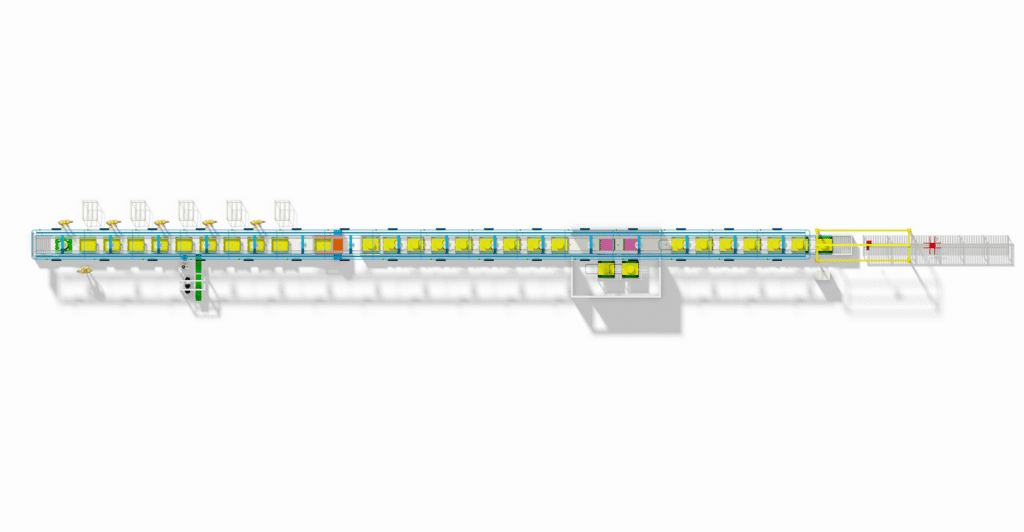
Conclusion: The differences between these two assembly lines are a direct reflection of the two distinct technological paths—electric drive and internal combustion engine drive—in the manufacturing phase. Choosing or designing which type of line depends not only on the product itself but also on a comprehensive consideration of production efficiency, quality control, initial investment, and operational costs. With the accelerating trend towards electrification, many traditional gasoline engine manufacturers are also modifying their existing lines or adding modules for electric products, creating mixed-model flexible production lines.
We can customize according to the client’s product specifications, production capacity or other requirements.
We provide comprehensive services including design, production, and installation/commissioning.